
Banco Popular de Puerto Rico


Banco Popular de Puerto Rico is a full-service financial services provider with operations in Puerto Rico, the United States and Virgin Islands. Popular, Inc. is the largest banking institution by both assets and deposits in Puerto Rico, and in the United States Popular, Inc.
-

Wildly different prices for the same medical procedures are reported across the nation: a knee MRI in Seattle can cost anywhere from $460 to $2,470; a hip replacement in New York runs $13,137 at Coney Island Hospital, or $38,588 at Lenox Hill. And those numbers dont even take into account differences in quality of care. This month, UnitedHealthcare expanded the availability of its myHealthcare Cost Estimator to nearly all of its employer-sponsored health care plans. The tool, which is free to employers and plan participants, allows for comparison shopping of health care services online and through the Health4Me app. [Image: Shutterstock]
May 29 -

By 2030, we will see 2.3 million new cancer cases in the United States, a 45% increase over 2010, according to the American Cancer Society. As the number of new cancer cases has increased, so too has cancer survivorship. Advances in cancer research and technology have brought life-saving breakthroughs in the fight against cancer, but the rapidly evolving science has also resulted in greater cost as patients take advantage of new diagnostic tools and procedures. Optum executives offer 6 employer strategies for managing the high cost of cancer care, based on a recent Optum white paper. [Images: Shutterstock]
May 22 -
As an employer, theres a lot you need to know in order to decide whether or not to offer health care through a health insurance exchange. But before you make a decision, Karen McLeese, J.D., vice president of employee benefit regulatory affairs for CBIZ Benefits & Insurance Services, details the general functions of all exchanges, including state-based, federal, or state/federal partnerships. Here are the eight primary features of exchanges. [Images: Shutterstock]
May 16 -

Buck Consultants talent and HR solutions Scot Marcotte, managing director, Chicago; Barry Hall, principal and innovation leader, Boston; and Steve Coco, principal and northeast region leader, New York, offer their predictions for the human resources world of the future. What will HR look like 20 years from now? [Images: Shutterstock]
May 14 -

Benefits managers and human resources professionals have, in many cases, been so frantically busy of late that they might not be thinking beyond 2014, or Oct. 1, or maybe even next week. But what will personnel management look like 10 or 20 years from now? How will the role of HR change? [Images: Shutterstock]
May 10 -
For the past 12 years, Unum reports, the leading cause of its long-term disability claims is cancer. Most people who have been diagnosed with cancer are very motivated to get back to work, says Kristin Tugman, senior director of health and productivity at Unum. It helps create a sense of normalcy and control at a time when people often feel understandably overwhelmed. Cancer is also Unums No. 6 cause of short-term disability. May is Disability Awareness Month. Here are the top five LTD and STD causes according to 2012 claims data from Unum. [Images: Shutterstock]
May 8 -
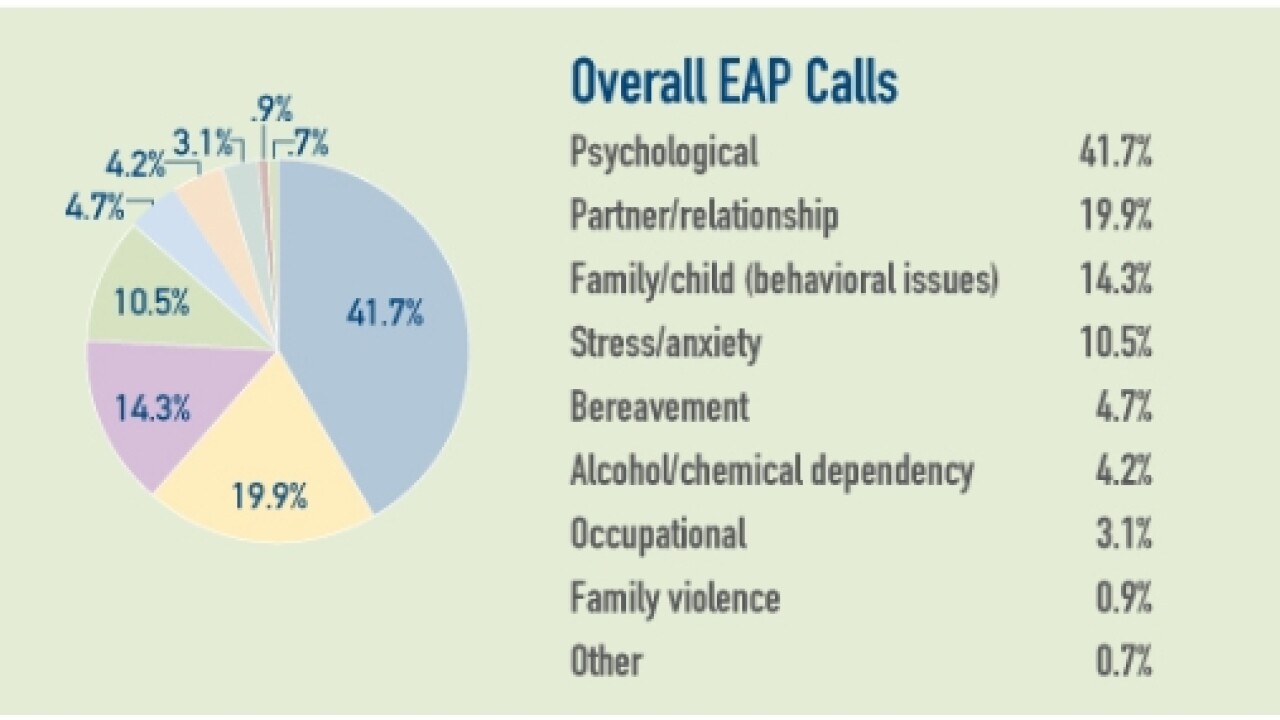
Employees seek advice from EAP/work-life resource hot lines for myriad reasons ranging from professional and financial concerns to help with mental health issues and substance abuse problems. To give employers a better understanding of the issues their employees face and who is likeliest to make use of employee assistance program benefits, ComPsych Corporation, which fields millions of calls annually, recently analyzed gender, age and industry differences in millions of EAP/work-life calls over a 12-month period.
May 3 -

Seventy-four percent of individuals reported experiencing at least one legal event in the past year, and a majority of those who did said it impacted their work, according to research from ARAG. Among those who went through some sort of legal event, 40% experienced four or more in the last year, up 20% from five years ago. Legal plan benefit offerings free to employers, practical to wage earners are growing in popularity for obvious reasons. [Images: Shutterstock]
May 1 -
The U.S. health care system wasted $418 billion on bad medication-related decisions in 2012. While the entire nation suffers from these costly decisions, they have a disproportionate effect on the poorest states. In fact, nine out of the 10 poorest states rank among the most wasteful, according to research from Express Scripts. Waste stems from using high-priced brand name medications instead of clinically equivalent generics, not taking medications as prescribed, and using more expensive pharmacies than necessary. Here are details on the most wasteful states, as well as the most frugal. How does your state stack up in prescription spending? [Images: Shutterstock]
April 26 -

With much of the world's purchasing power located outside of the U.S., the chances are your company will, at some point, expand into new countries. When looking at a benefit strategy outside of the U.S., its important to be flexible enough to accommodate local norms while maintaining regulatory compliance. EBN Contributing Editor Shana Sweeney offers five tips to get you started. [Images: Shutterstock]
April 23


