Hardship withdrawals hit record high, underscoring retirement risks

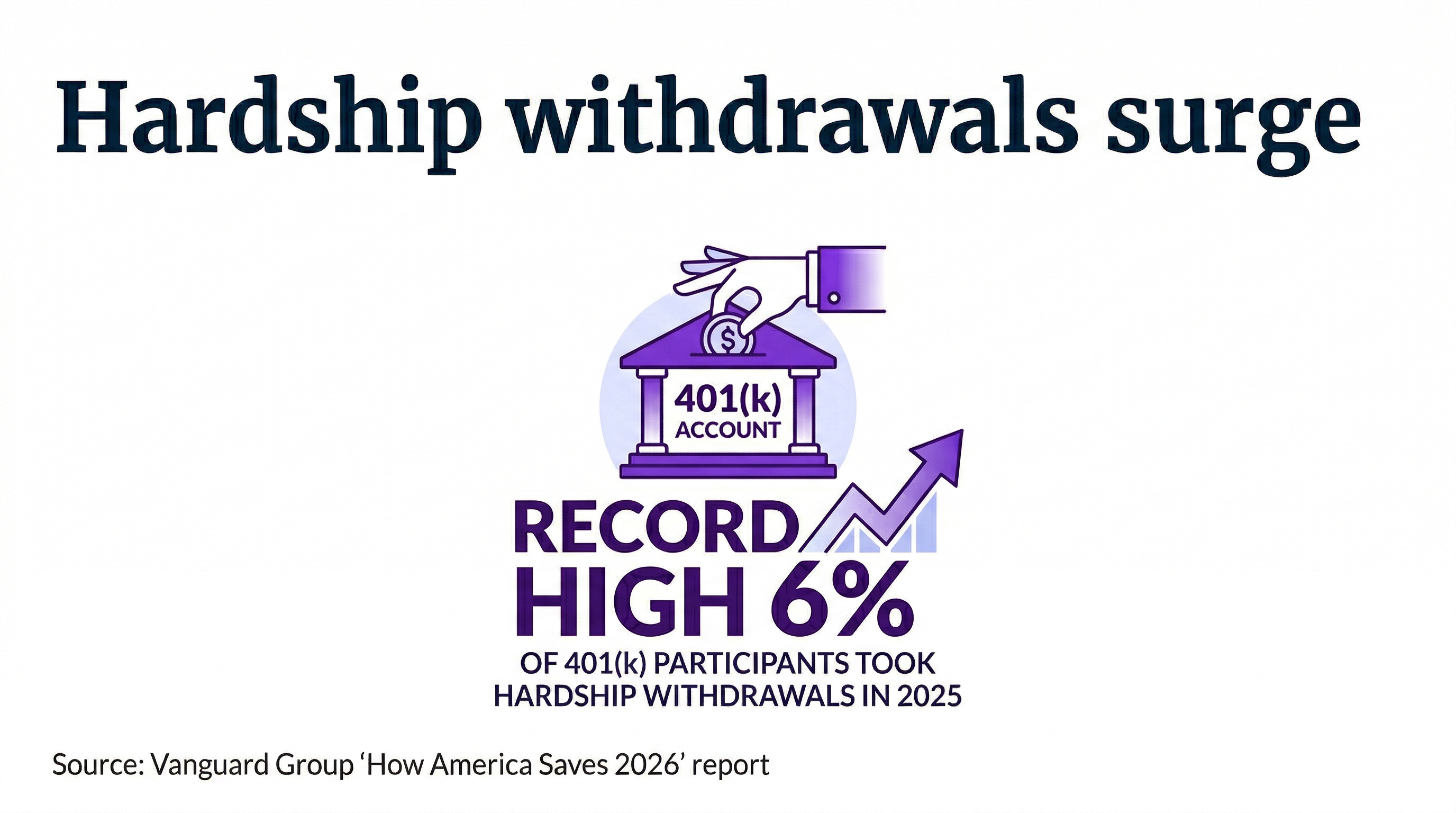
Infographic showing record 6% of 401(k) participants took hardship withdrawals in 2025. Source: Vanguard.
Visualization created with AI assistance based on original reporting.
  • Key Insight: Learn how rising 401(k) hardship withdrawals are shifting retirement and long‑term care planning dynamics.  
  • What's at Stake: Eroding retirement assets could increase future Medicaid dependency and employer benefits liabilities.  
  • Supporting Data: Vanguard: 6% of 401(k) holders took hardship withdrawals in 2025; median withdrawal $1,900.  
    Source: Bullets generated by AI with editorial review

More U.S. workers are withdrawing funds from retirement plans ahead of schedule, raising concerns about long-term financial and healthcare security.


Processing Content

"The biggest mistake is treating retirement assets like a pool of money for isolated decisions instead of part of one coordinated lifetime plan," says Lily Vittayarukskul, CEO and founder of Waterlily, a startup that uses AI to help individuals and families plan for long‑term care and major financial decisions. 

"People often make withdrawals to solve for the need right in front of them, without pressure-testing what that does to their future housing, healthcare, and long-term care capacity," Vittayarukskul added.

New data from investment management company Vanguard Group shows that a record 6% of 401(k) account holders withdrew funds in 2025 to cover financial hardships. This marked the sixth straight year that hardship withdrawals have increased, according to Vanguard's "How America Saves 2026" report. 

The median hardship withdrawal amount in 2025 was $1,900, and nearly half of participants took multiple distributions, essentially using their retirement plans as emergency savings. While a couple of small taps over a 30- to 40-year career are unlikely to affect retirement readiness, frequent early access over time can jeopardize retirement savings,  the report noted.

Read more: 4 Social Security mistakes that hurt retirement benefits

Underscoring the importance of saving for healthcare needs in retirement, Vittayarukskul points out that national health expenditures are expected to grow 5.8% annually on average through 2033, outpacing GDP growth. 

"The real issue is not that people ever touch retirement savings," she says. "It is that they do it without a full asset map and without being clear which dollars are meant for lifestyle, which are meant for emergencies, and which may need to protect them from a very large future care event."

A 'mainstream' risk

Waterlily uses AI to forecast when people might need long-term care and how much it could cost. Users enter basic health, family and financial info, and the platform models personalized timelines and funding options, including insurance or self-pay, giving families and advisers a clear, data-driven road map for planning.

"Waterlily accounts for the fact that future care is not funded in today's dollars, and that is a major issue in this economy," Vittayarukskul says. "We project future care costs forward because healthcare costs do not stay flat."

Families and individuals planning for retirement often run into trouble when they assume that long-term care is either unlikely or someone else's problem, Vittayarukskul says, adding that misconceptions about Medicare also play a factor. Medicare generally covers long-term care only when skilled or rehabilitative services are needed after a hospital stay, usually for short periods, and typically limits nursing home coverage to 100 days.

"The mistake to avoid is spending or reallocating assets that may ultimately be needed to fund care, without first identifying which assets are actually serving as your long-term care backstop," Vittayarukskul says. 

Read more: Employees are turning 65 with no plans to retire: What this means for benefits

It can be easy to forget about long-term financial and health care planning in times of economic uncertainty — with oil prices on the rise and AI disruption in the workforce — but families should always be thinking about the future, Vittayarukskul says. 

"Long-term care is not a fringe risk. It is a mainstream retirement risk, and Medicaid remains the nation's largest payer of long-term services and supports," she says. "That means the right framing is not debt versus emergency savings versus long-term care planning. It is sequencing them intelligently. Families should stabilize their present, but they also need to quantify the future care risk early enough to do something about it."


For reprint and licensing requests for this article, click here.
Retirement Financial wellness Employee benefits Healthcare
MORE FROM EMPLOYEE BENEFIT NEWS