- Key Insight: Learn how broad retirement account participation masks significant retirement readiness gaps.
- What's at Stake: Unexpected expenses could trigger widespread shortfalls, affecting workforce retention and benefits policy.
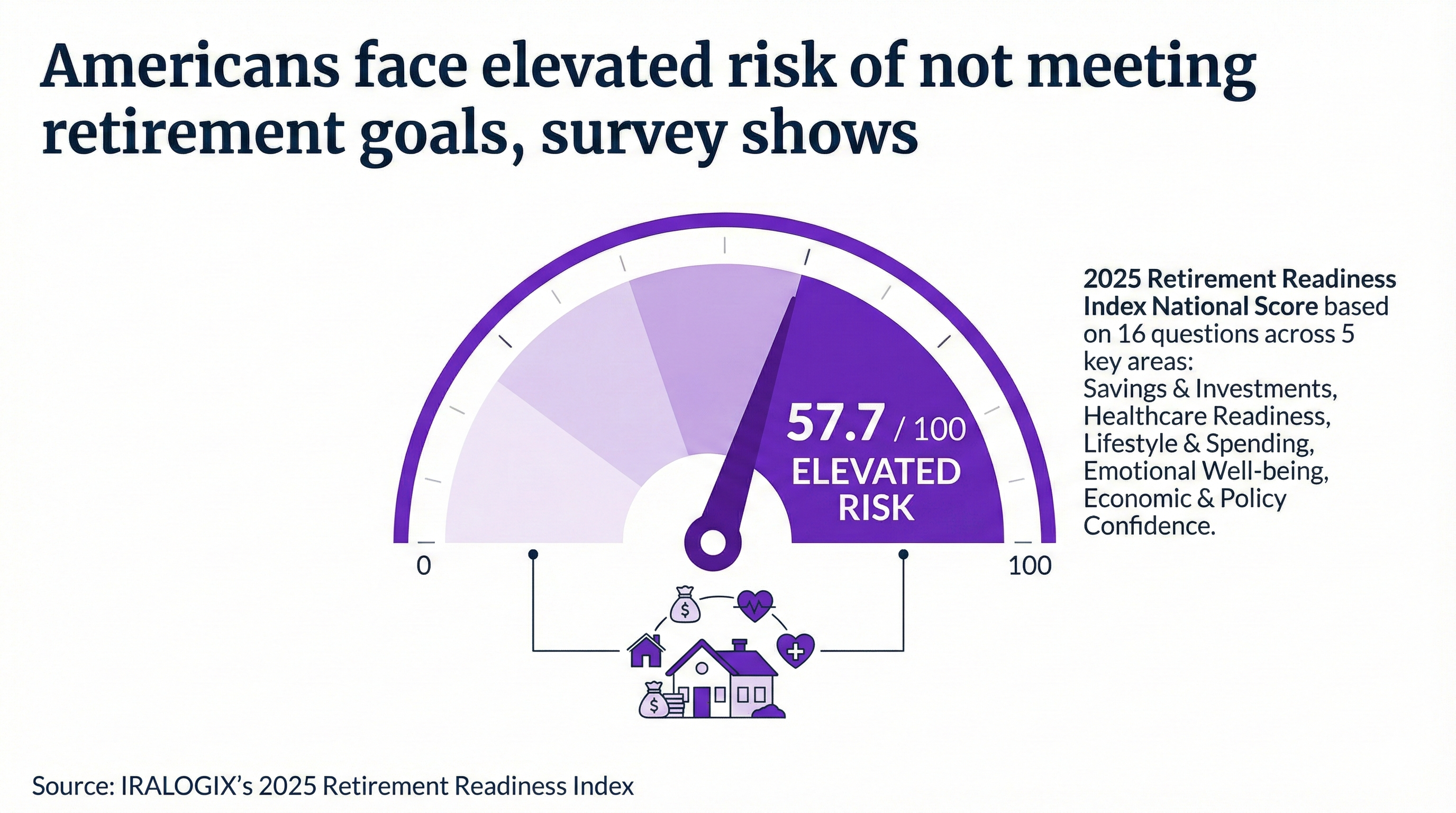
- Supporting Data: 2025 Readiness Index scored 57.7/100, placing Americans in "elevated risk."
- Source: Bullets generated by AI with editorial review
Americans are at an elevated risk of not reaching their retirement goals despite broad participation in savings and investment accounts, according to a new national survey.

The findings by retirement provider IRALOGIX show that many Americans are just one unexpected expense, job disruption or healthcare event away from falling behind.
IRALOGIX's 2025 Retirement Readiness Index assesses how
Everyone has a
Read more:
"Every American worker deserves a retirement that's full of dignity … as they live out their later years," de Silva says. "This [data] says many Americans may not achieve even that baseline goal. It also indicates to me that the system is not perfect."
Key findings
The 2025 Retirement Readiness Index national score registered 57.7 out of 100, placing overall retirement readiness for the year in the elevated risk category.
Of the five areas evaluated, savings and investments ranked the strongest, revealing broad participation in retirement accounts, though contribution consistency remains uneven. Lifestyle and spending showed moderate strength, suggesting many households manage day-to-day finances but lack confidence in sustaining their lifestyle through retirement.
Emotional well-being remains relatively stable, indicating that confidence and outlook have not collapsed despite ongoing economic uncertainty.
Meanwhile, healthcare readiness ranked among the weakest areas, highlighting limited preparation for medical and long-term care costs.
"Retirement readiness is about
For many families, one of the greatest barriers to increasing retirement savings is the absence of a rainy-day fund, de Silva says.
Read more:
According to a 2025 study by Empower, the median emergency savings for Americans is $500, and one in three have no rainy-day fund. Twenty-nine percent say they can't afford an unexpected expense over $400.
The size of the safety net varies by generation, the study found, with Boomers saving a median rainy-day fund of $2,000 — five times that of Gen Z's reserves of $400.
Read more:
Ideally, families should have about six months of liquidity, de Silva says, enough to cover a medical emergency, auto repairs or any other unexpected expense that inevitably comes up.
"That gives you the comfort to put some money away for the longer term," de Silva says. "I think the other issue is that Americans understand that if they put that money away for the longer term, they're penalized if they take it out early … We want to make sure Americans don't see their retirement plan as a source of near-term liquidity."
Benefit leaders can play a big role in
"The bottom line is companies that get this are going to retain and attract talent much better than companies that don't," he says.