Even happy workers can't stop worrying about AI and the job market

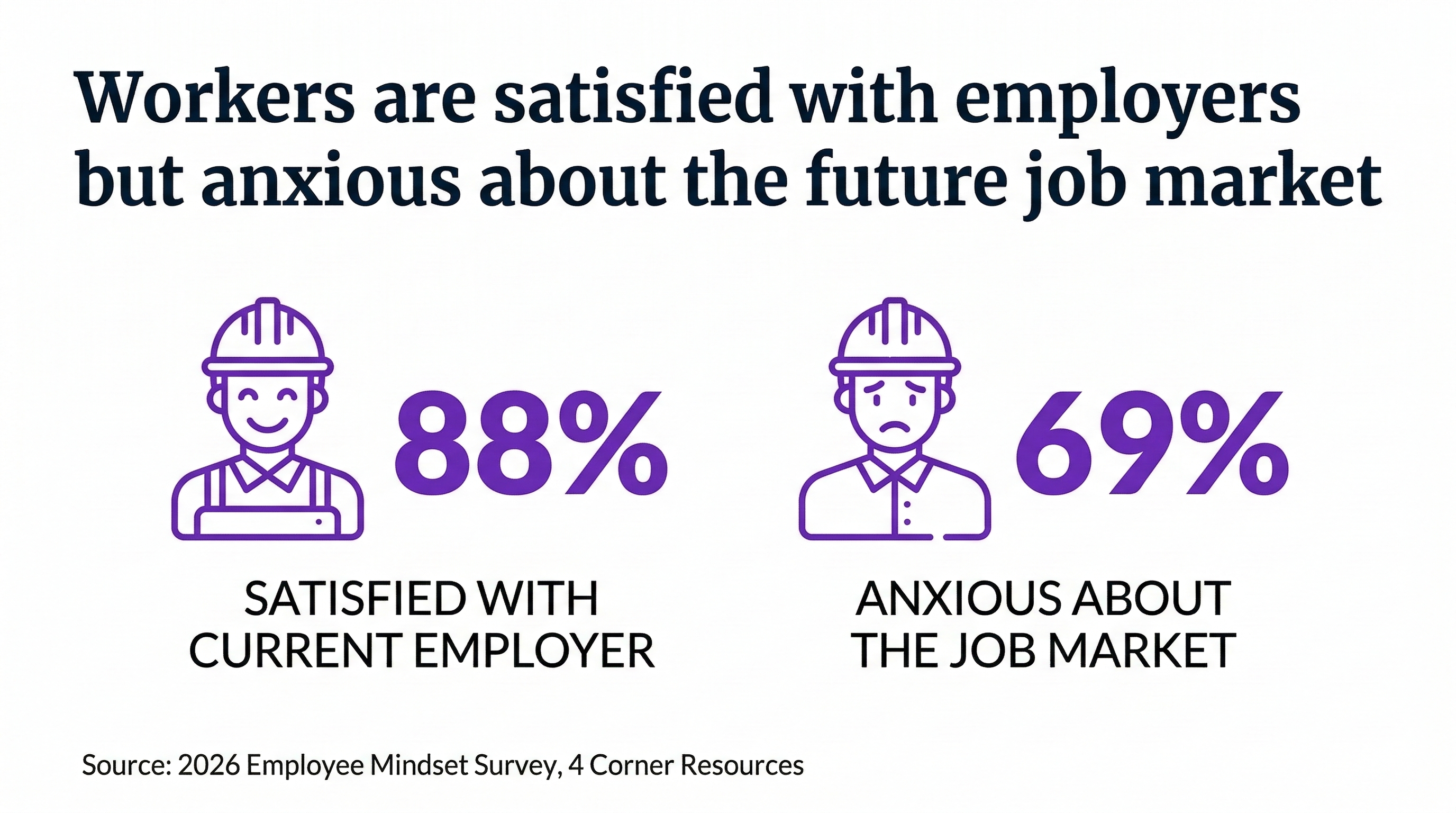
Comparison of worker views: 88% satisfied with employer (smiling icon), 69% anxious about job market (frowning icon).
Visualization created with AI assistance based on original reporting.
  • Key Insight: Discover how executive-led AI adoption is redefining employee value and future job roles.
  • What's at Stake: Labor-market anxiety could trigger talent flight, higher benefits costs, and operational risk.
  • Supporting Data: February jobs report: 92,000 positions cut; unemployment rose to 4.4%.
  • Source: Bullets generated by AI with editorial review

Most U.S. workers are satisfied with their jobs, but fears about the broader labor market are growing, according to a new report.


Processing Content

The 2026 Employee Mindset Survey by 4 Corner Resources also revealed that workers are increasingly concerned that AI will threaten their jobs within three years. The new survey —which found that 88% of workers are satisfied with their employers, yet 69% are anxious about the job market — comes amid a weaker-than-expected February jobs report that showed U.S. employers cut 92,000 jobs, while the unemployment rate rose to 4.4%.

Read more: AI is quietly giving bad advice to your workforce. Leaders should pay attention

"Employers need to be sensitive to the fact that it's a really tough job market right now, especially for young professionals," says Pete Newsome, president of 4 Corner Resources. 

Financial fragility and workplace stress are also on the rise, the survey found, with 45% of workers reporting that they have less than three months of emergency savings. For benefit leaders, this means that strategies around financial wellness are becoming critical, Newsom added. 

Workplace stress rises with seniority: 24% of executives report high or extreme stress compared to 18% of entry-level workers. Just 14% of workers report zero stress. 

Read more: Employees cite finances as leading barrier to workplace well-being

Newsome recently spoke with Employee Benefit News about the findings of the Employee Mindset Survey and how benefit leaders should respond to it. This interview has been edited for length and clarity. 

What are some of your biggest takeaways from this report?
I'm very focused on AI's impact on the job market right now. It's a different kind of technology than what we're used to, where typically the younger generations are faster to adopt new technology. But we're seeing executives are using it significantly more, and those who are using it more are most afraid of AI's impact on the job market. I put myself in that category as well, as a heavy user. I don't think it's getting enough attention, and that's something that concerns me for many reasons.

How does AI concern vary across job levels, and what impact will the rise of AI have on long-term job security?
The impact is going to be bigger than a lot of people acknowledge right now. I don't think anyone really knows what the time frame looks like, but workers should be leveraging it heavily right now to improve their own job functionality and to make them more valuable for their employer. We see evidence of those employees who are doing that having more opportunities wherever they work today, as well as in the job market. It's going from almost a "nice to have" to mandatory, and I think we're going to see that transformation continue throughout 2026.

What workplace benefits do employees currently value most, given the financial vulnerability revealed in the survey?
Healthcare is extremely important, and compensation is always No. 1. But flexibility is huge right now for employees, and that's a battle where we've seen a lot of push and pull since COVID. Employees really want a lot of work-life balance right now. Employers have so much control right now, almost to an unhealthy degree. I like to see balance there. We saw the pendulum swing so far post-COVID, and now it's gone in the other direction.

Are there any demographic groups that are showing the highest anxiety about future employment?
The younger workers are worried. When you look on social media, you think no one likes their job, but our data indicates otherwise. Employees are generally satisfied right now, and that could be that they feel fortunate to have a job when they know so many people who don't.

What's the most important message that  benefit leaders should take away from this survey? 
You should be aware of the AI threat, and you should train your team to have those capabilities. Whether you're paying attention to it or not, the market is very much paying attention to it. The survey data also showed that people want to be trained, and I think very few employers are doing that right now to a significant degree. The second one is communication. People are afraid. There's a good chance that people may be increasingly afraid of the market in the not too distant future, so do your best to allay those fears and be open and transparent wherever you can.


For reprint and licensing requests for this article, click here.
Industry News Hybrid Work Workforce management Employee benefits
MORE FROM EMPLOYEE BENEFIT NEWS