'Just for show': Superficial AI strategies are ruining adoption

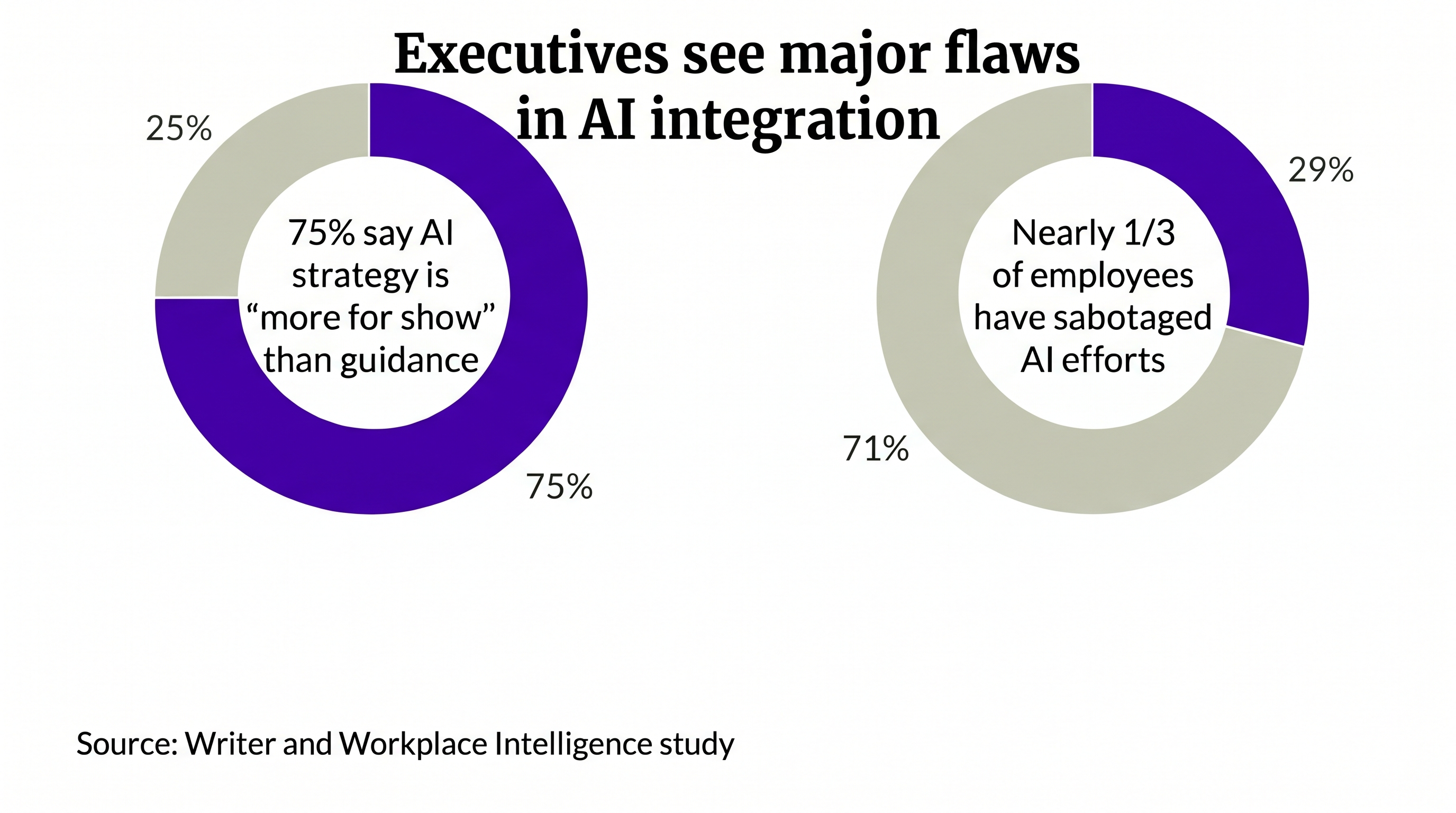
Charts depicting AI survey results
Visualization created with AI assistance based on original reporting.
  • Key insight: Learn why AI adoption succeeds when redesign centers human-agent collaboration, not just mandates.
  • What's at stake: Competitive edge, retention and compliance risk hinge on effective workforce AI integration.
  • Supporting data: 59% of executives claim a clear AI vision, but only 8% of employees agree - Betterworks
    Source: Bullets generated by AI with editorial review

Processing Content

You can order employees to use AI, but it takes more than a mandate to get them to embrace it. 

Employers are seeing positive usage of AI in areas like benefits understanding and hiring practices, but when it comes to successful integration into daily workflow, employees are less enthusiastic. A report from performance management platform Betterworks shows 59% of executives think they've communicated a clear AI vision to their workforce, but only 8% of employees agree. 

This is something leadership has to amend, says May Habib, CEO and co-founder of enterprise AI agent platform Writer. "The leaders who are putting in the work to radically redesign operations with human-agent collaboration at the center are the ones compounding their advantage in ways competitors can't replicate," she says. "AI transformation is ultimately about people, and the future belongs to the companies putting agent-building power directly into the hands of people closest to the work."

Read more:  Cutting employee compensation to invest in AI could backfire 

But new research from Writer and research agency Workplace Intelligence confirms there is still a long way to go. Of 2,400 global employees and executives surveyed, 92% of leaders say their goal is to build a workforce of "AI-elite," and 87% report that "AI super-users are at least five times more productive than employees who aren't embracing AI." Yet, nearly half feel AI adoption thus far has been a massive disappointment, 39% say they don't have a strategy in place to drive revenue from AI tools and 55% say AI use as a "chaotic free-for-all" at their company. Seventy-five percent said their strategy is "more for show" than real guidance.

As a result, employees are rebelling: 29% — 44% of Gen Z — said they've sabotaged their employer's AI strategy in ways such as entering company information into public platforms, using tools that aren't approved or simply refusing to use the technology. Three quarters of executives admit this type of behavior poses a threat to their company's future. 

These issues are shaking up the C-suite as well: 79% of executives said they've struggled with lagging ROI and strategy gaps, 38% of CEOs reported high or crippling stress around AI strategy, and 64% said they fear losing their job if they fail to make a successful transition. 

Create an empathetic strategy, not a charade

Rather than a disorganized forced march, leaders should recognize that everyone's experience with AI will look different, and approach any skepticism with empathy, says Caitlin Collins, an organizational psychologist and program strategy director at Betterworks. 

"Step outside of your own responsibilities and what you own for a minute, because across industries and job functions, this is going to be going to vary a lot. We've got our technical people who are ramping up like crazy on AI understanding and how to lean into it work and help their job, but we have a number of other sectors and job functions where employees are really nervous about it," she explains.

Read more:  Financial firms expand pooled retirement plans for small employers

The goal is to get employees to adopt AI by choice because they feel confident using it and they see the value it brings to their work, Collins says. They need training on how to adapt it to their role, and then they need time to become proficient. 

Employees are more likely to respond well and be successful when you let them digest it, get their hands dirty with it, play with it, and then understand it, she explains. "We have to bring them on a path … to learning it, versus just giving them a mandate."

Collins suggests on-the-job training using employees' real tasks and projects as a way to build comfort. While it should be made clear that using AI is expected, incorporation should be done at a comfortable cadence, allowing people to develop skills at their own pace, and with a leadership attitude of, "let's see how we can use this to double what you do," she says.  

Even after successfully implementing AI tools, Collins recommends having experts who can help employees when they have questions or concerns. This is especially important for issues of regulation and compliance — training employees on safety and what they can and cannot do, she emphasizes. 

"There's always got to be an open line of communication. This isn't a situation where we tell an employee once, because if they get it wrong, it's punitive. "It's got to be a process where there's like an open forum and mentors they can go to."

Read more:  A concierge benefit tackles personal to-do lists, boosts productivity

As AI continues to evolve, organizations that build a trustworthy, efficient process for implementation will be the ones that come out on top, Collins says. 

"Your people are your number one asset; retention and making them happy and high performance are business values," she says. "It's a concept in change management that connects to the saying, 'You can lead a horse to water, but you can't make him drink.' What we want to do is lead employees to water and want them to want to drink."


For reprint and licensing requests for this article, click here.
Technology Workforce management Professional development
MORE FROM EMPLOYEE BENEFIT NEWS
Load More