- Key Insight: Learn how widespread AI intent contrasts with weak operational scale in HR functions.
- What's at Stake: Falling short could erode talent planning and competitive positioning across organizations.
- Supporting Data: 88% plan increased AI spend in 2026; only 9% report strong AI expertise.
- Source: Bullets generated by AI with editorial review
Most organizations plan to increase their investment in AI technologies over the next year, but few are ready to scale it, according to a new report by software company Avature.
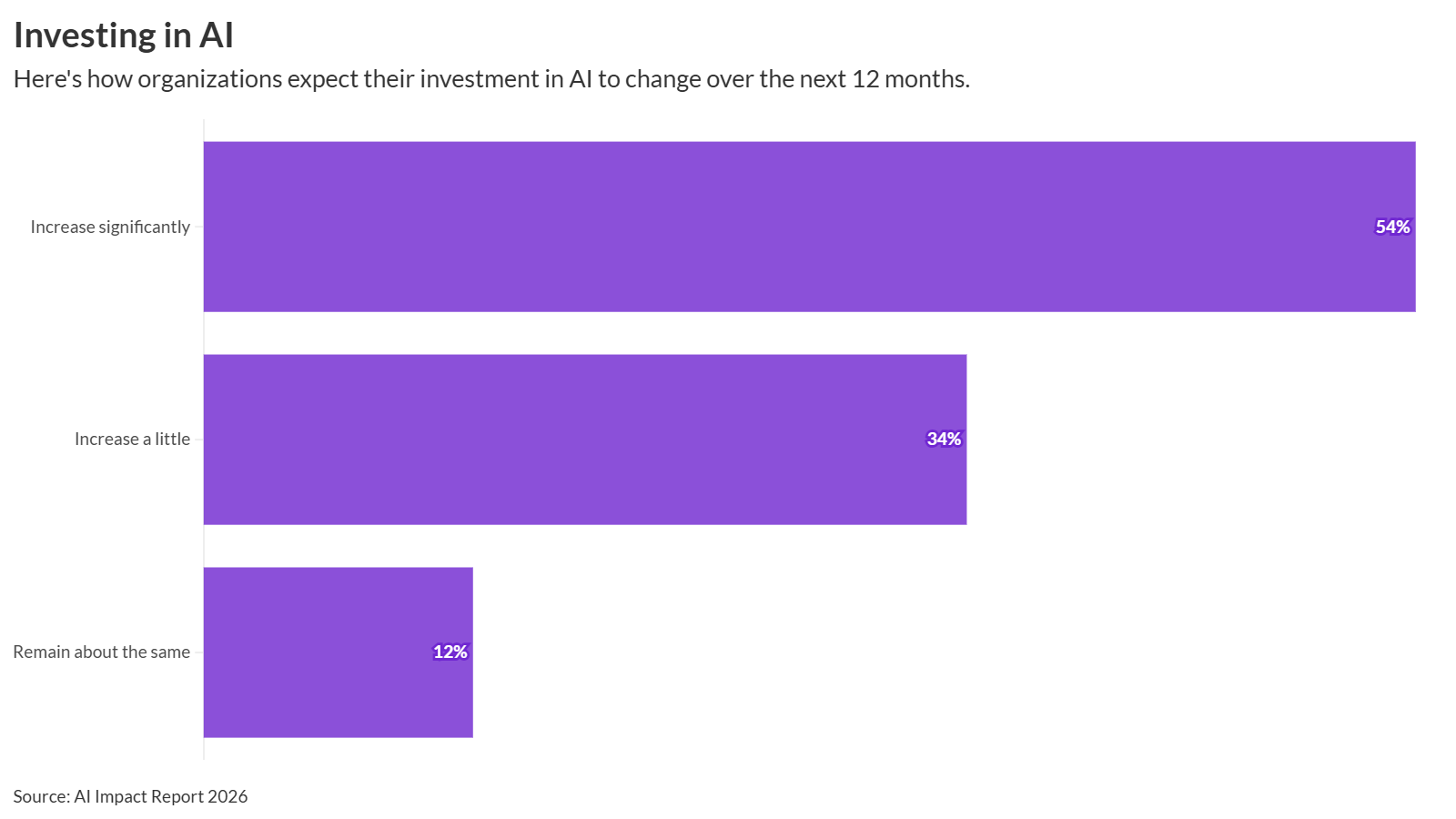
The report examined how HR teams are applying AI technology across hiring, skills development and workforce planning. While 88% of organizations say they plan to spend more on AI in 2026, 51% admit they remain in the exploratory phase, assessing use cases, running pilots or building foundational understanding.
An even smaller segment — 23% — say they are
"I think one thing that this report shows is that there is more hype than there is deployment," says Dimitri Boylan, founder and CEO of Avature. "A lot of professionals right now are panicking because they haven't deployed enough artificial intelligence."
AI is forcing companies to go
Lack of skills
Despite increased investment, several factors are holding companies back from realizing the full potential of AI, the report found. The biggest challenge is skills shortage: 48% of respondents said they are struggling to find or develop the capabilities needed to fill critical roles, while 31% cite
Additionally, 28% of respondents see legacy software limitations as one of the function's top obstacles.
"I think the biggest challenge for HR in terms of AI skills is that they're being asked to predict the skills that the organization needs for the future," Boylan says. "That really requires understanding how AI impacts all of the different roles that you have in the organization."
According to Avature's survey, only 9% of companies say they have
Read more:
Only 11% feel "very confident" predicting the skills their organization will need in the next year.
"HR is struggling with how AI will change HR roles," Boylan says. "That's a reasonable struggle to have, but at the same time they're being asked to predict how AI is going to change every other role in the organization … They can lead the process, but they can't figure that out alone. That's a heavy lift, and there are a lot of unknowns today that make it difficult to predict that."
The trust factor
Another factor that prevents companies from scaling AI is trust. Just 2% of respondents said they

Employees have similar reservations: While 68% reported feeling excited or relieved when AI took on part of their workload, 22% remained skeptical and noted that they check the AI every time they ask the technology to complete a task.
Read more:
However, respondents expressed confidence when giving AI repetitive, rules-based tasks. For example, 70% trust it to answer candidate FAQs, 64% to match candidates to roles and 63% to resolve simple employee requests.
Most respondents said they also
"For HR, there's a lot of low-hanging fruit," Boylan says. "If HR manages to get a lot of repetitive, low value-added tasks pushed off to AI, they don't have to worry as much about safeguards. It's very basic stuff. But as they move further up the complexity spectrum for processes and the AI starts doing more things, then they will have some challenges there."