Endless meetings and apps leave employees struggling to focus

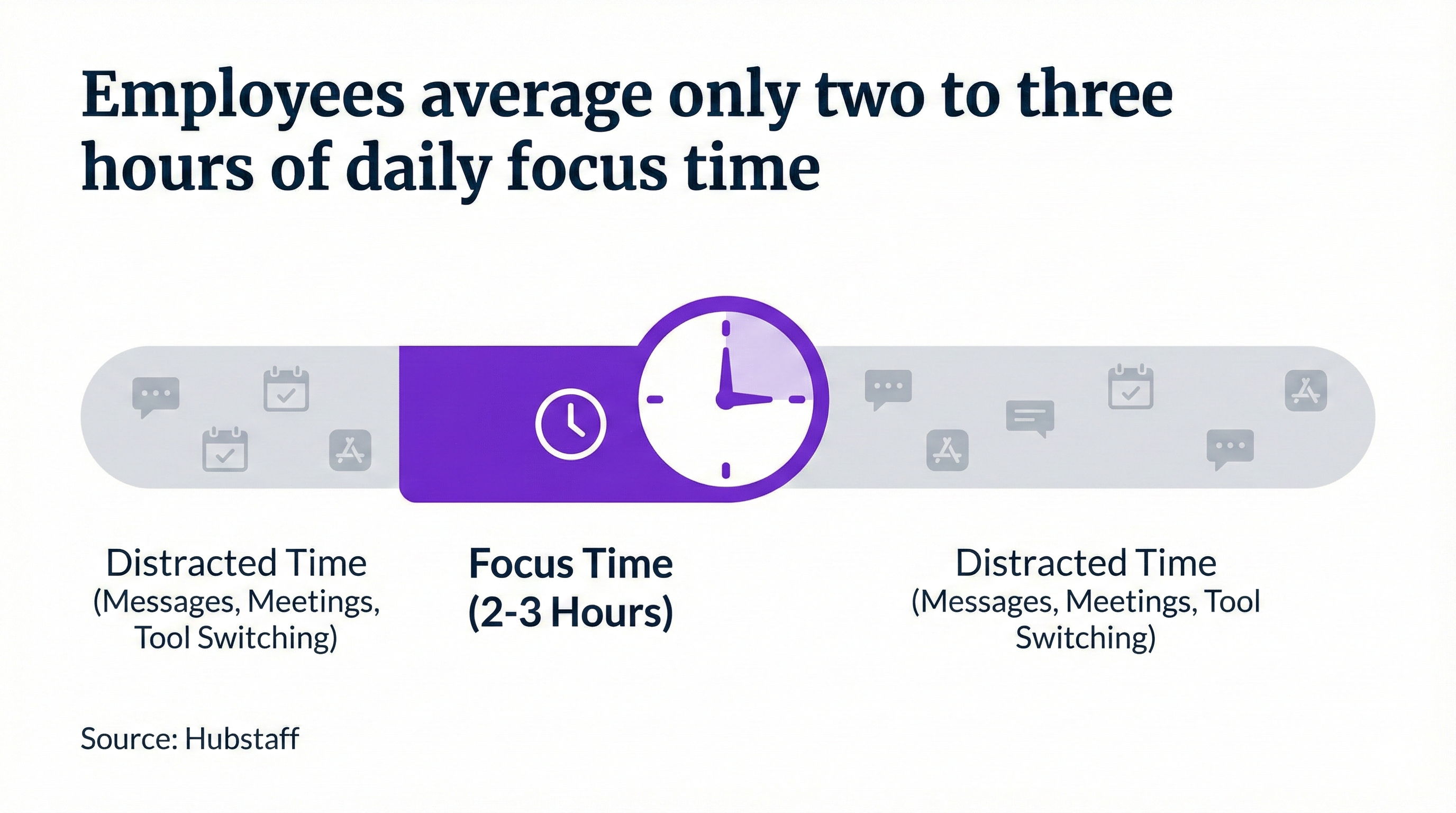
Infographic: Employees average 2-3 hours of focus time daily. A timeline graphic illustrates limited focus periods versus distracted time.
Visualization created with AI assistance based on original reporting.
  • Key Insight: Discover how organizational rhythms — not individual willpower—are driving vanishing focus time.  
  • What's at Stake: Rising meeting density could erode productivity and undermine AI ROI across teams.    
  • Forward Look: Prepare to formalize focus blocks and meeting hygiene as core workplace policies.
  • Source: Bullets generated by AI with editorial review

Thumbing through cellphone apps. A popup reminder for an upcoming meeting. Rapid-fire messages from Slack. 

Processing Content

Lose your focus yet? 

This is the reality that many workers live in today — one where focus time is an ever-rarer commodity. In fact, according to a recent study, the average employee gets just two to three hours of focus time per day, meaning uninterrupted work periods without meetings, messages, or tool switching.

"Our data proves that teams aren't failing at productivity, they're working in systems that constantly disrupt focus," says Jared Brown, CEO of Hubstaff, the company behind the 2026 Global Benchmarks Report. "When a worker's day is fragmented by meetings, messages and tool switching, real focus is out of reach. If leaders want better performance and real returns on their AI investments, they need to treat focus time as a core operating principle, not simply a personal responsibility."

Too many meetings

One of the top reasons workers can't maintain their focus is increased meeting volume. Compared to just two years ago, the average person is now sitting in twice as many meetings per year and the typical organization is running almost six times as many meetings, according to Hubstaff data. 

A 2025 Work Trend report by Microsoft found that half of all meetings take place between 9-11 a.m. and 1-3 p.m., when many people have a natural productivity spike in their day due to their circadian rhythms. 

In order to maximize focus time, Brown says he groups meetings together with his employees at Hubstaff, allowing them to knock out these obligations within a block of time. He also creates focus blocks in which people have a set number of hours to go off the grid and — as he puts it — "just bust stuff out." 

Read more: 30 days, zero meetings: One company's experiment with work-life balance

During these blocks, he suggests closing instant messaging apps, email applications and other apps to minimize distractions. One other thing that can help: killing unnecessary meetings. Brown says there are some tasks that can be accomplished through a quick chat instead of formal gathering.

"It could take three minutes, and we're done," he says. "If you schedule it and put it on the calendar, now three people are involved. You almost feel like it needs to run a full 30 minutes. We've lost a little bit of, 'Let me just run over to your virtual cubicle and ask you a quick question.'"

In addition to juggling meetings, workers are also struggling to navigate the numerous tools that draw their attention — Hubstaff data shows workers are using an average of 18 apps per day, and those in sales/marketing, customer success and administrative/HR roles are averaging more than 20 per day. 

Read more: 5 leaders share best practices for bringing employees together

"A lot of these applications are pretty noisy," Brown says. "Slack and Teams are probably the biggest culprits of this, and it feels like we've brought a lot of the distractions that existed in the office space into the remote office environment through the computer. (As a result) focus time is low compared to what people believe they're getting every day."

Hybrid workers reported the least amount of focus time, with just 31% of hours in deep focus. Fully-committed work styles reported the most: 41% of hours for remote teams and 45% of hours for in-office teams. 

In order to improve focus time, Brown says benefit managers should start by raising awareness around the topic with other leaders in their organization.

"We're big proponents of measuring it," he says. "If you measure it, then you can improve it and have some concept of how much time you're focusing throughout the day. That's a really good way to tackle it." 

For reprint and licensing requests for this article, click here.
Workplace culture Industry News Workforce management Hybrid Work
MORE FROM EMPLOYEE BENEFIT NEWS