- Key Insight: Learn how mounting cost pressures are forcing employers to rethink benefit affordability trade-offs.
- What's at Stake: Rising healthcare costs could erode talent retention and increase employer financial exposure.
- Expert Quote: Robby White warns this open enrollment was exceptionally challenging due to sticker shock.
- Source: Bullets generated by AI with editorial review
Part 1 in a series of top takeaways from this year's open enrollment.
A clear tipping point may have been reached
"In talking to people out in the field, it was one of the most challenging open enrollments," observes Robby White, U.S. benefits business line leader with Gallagher. "It seems like decisions were delayed quite a bit because of the sticker shock of some fully insured increases, as well as our self-insured clients seeing a hardening stop-loss market."
He says the signs were everywhere: High-cost claimants continuing to drive up overall costs; his GLP-1 customers seeing a 27% rise in their expenses; and employees taking on average about 7% more in terms of their out-of-pocket healthcare contributions.
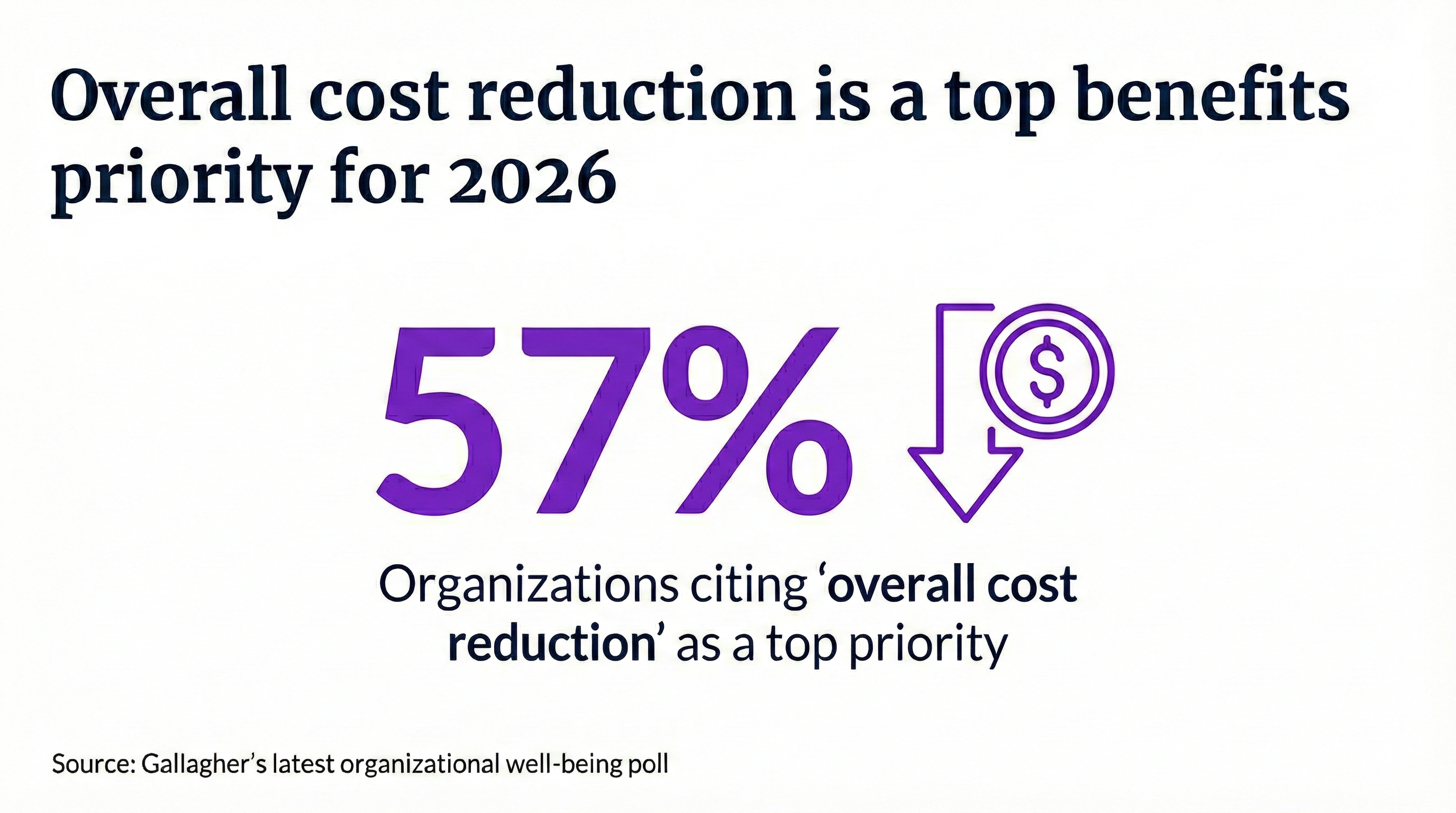
It may not be all that surprising that Gallagher's latest organizational well-being poll of more than 200 organizations found that "addressing affordability" and "overall cost reduction" are now the top two benefits strategy priorities for 2026 at 66% and 57%, respectively.
Read more:
Many employers sought to figure out how much cost-sharing they could implement without upsetting their workforce and what needed to change in the face of healthcare cost increase, according to Nick Bellanca, a vice president and market leader at Lockton. "It was really dependent upon how well each individual company was doing financially and what their cost increases looked like," he reports.
GLP-1's balancing act
Whatever their responses were, they all shared the same goal: Balancing the cost of their benefit programs against employee satisfaction, not just with benefits, but the company overall. "If we look at the renewal process leading up to the open-enrollment process, I think leadership and businesses were taking a more thoughtful approach," says Perry Braun, president and CEO of Benefits Advisors Network.

The best example of this is
He believes that employers, health systems and insurance carriers are all concerned about rising utilization and cost within GLP-1 categories, but wonders
Read more:

For Chelsea Gates, regional employee benefits practice leader for USI's mid-Atlantic region, the most recent open enrollment felt much like 2020 when the pandemic created instability in both work and life.
"We saw an interesting confluence at the end of the year going into January of a world that felt a little unstable under people's feet in general economically and politically, and employers wanted to be sensitive to that and minimize change as much as possible for people who were already feeling like they were on unsteady ground," she says.
The big takeaway for Gates and her team was a need to implement an overarching strategy for each one of their employer clients that would persist through market change. The trick was to avoid being tugged too far in one direction or another by a high renewal or need for plan design changes, staying focused on overall growth strategies and culture.
Noting that change can be hard to accept at open enrollment, Braun says it's infinitely easier and less expensive for employers and their consultants to produce, content and distribute content than it was 25 years ago. That, of course, bodes well for improving benefits literacy and reducing employee friction.
"Whether or not they're reading it or subscribing to it, that's a different conversation," he hastens to add.
Stay tuned for part 2 of this on-going series about lessons learned from this year's open enrollment.