How off-hours care options help working parents remain present all day

UrbanSitter research on working parent struggles with child care challenges
Visualization created with AI assistance based on original reporting.
  • Key insight: Discover how employer-backed platforms integrate camp and backup care for school-age children.
  • What's at stake: Unaddressed school-break care risks talent retention and productivity across sectors.
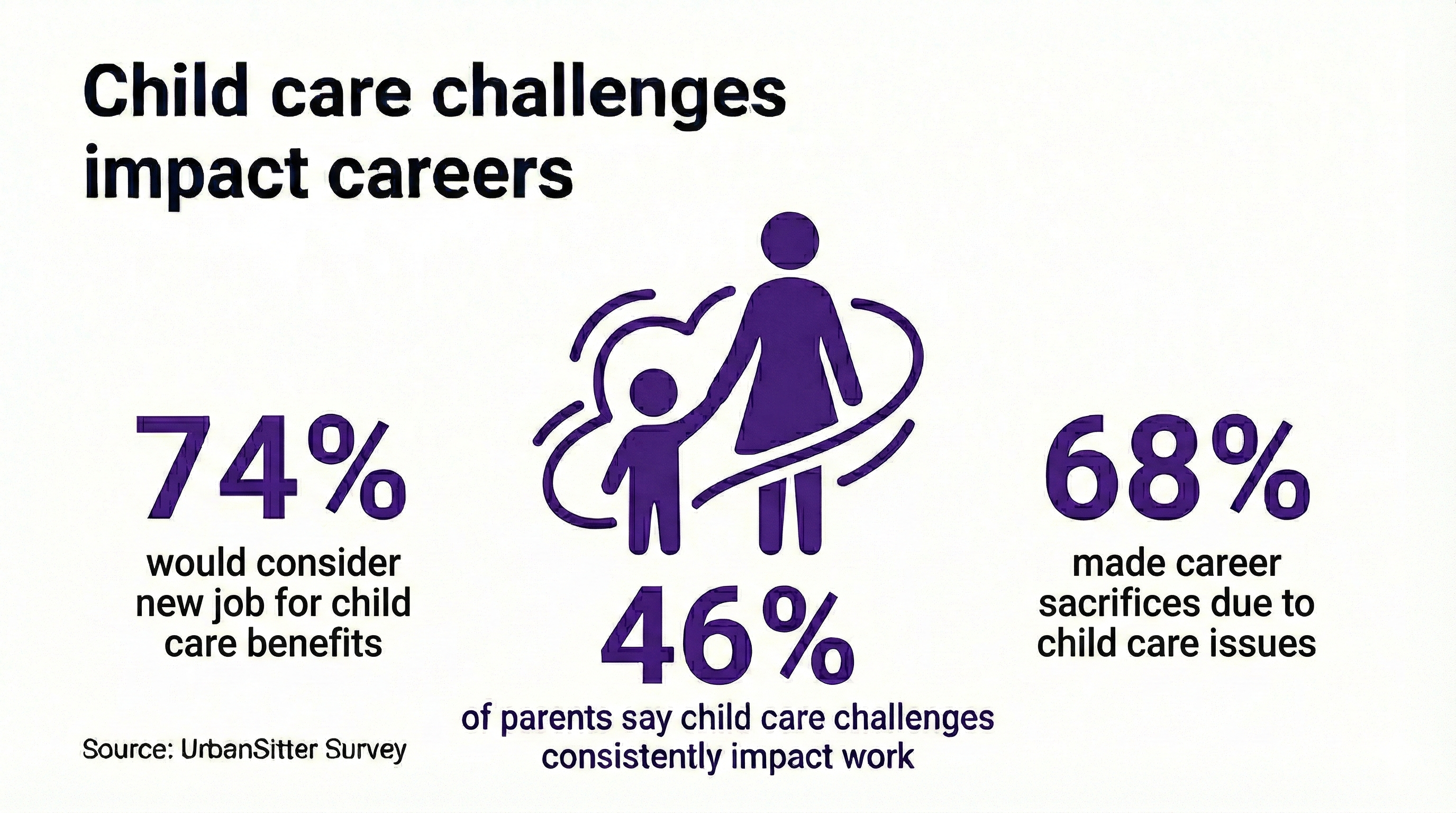
  • Supporting data: 46% of parents report child care regularly impacts their work — survey data.
  • Source: Bullets generated by AI with editorial review

Processing Content

Child care challenges don't disappear when children go to school — in fact, navigating seasonal breaks and after-school care can make things more complex for working parents.


Forty-six percent of parents say child care issues regularly impact their work, and nearly 70% have had to make career sacrifices because of these, from reduced hours and responsibilities to leaving the workforce altogether, according to a survey from UrbanSitter, a platform that connects members with vetted forms of family care such as babysitting, nannies, elder and pet care. Those without access to employer support have higher levels of stress, and 74% said they would consider accepting a new job if child care benefits were offered. 

Traditional schools are typically in session for 180 days, leaving approximately 16 weeks of care unaccounted for. To help employers support parents with school-aged children, UrbanSitter has teamed up with ActivityHero, which provides an updated list of local summer and holiday camps, as well as after school and family activity options. Parents can sort by location, dates needed, interest type, and in-person or online experiences for kids ages four through 18. 

"They are focused on non-traditional hours, whether it's summer camps or after-school programs, and we think they do a really high-quality job," says Lynn Perkins, UrbanSitter's CEO. "Oftentimes when HR teams come to us, [it's for] that critical backup-care need. [This] extends our reach; we're able to help with [care for] school-age kids in a way that every family needs."

Read more:  Child care surpasses retirement as top work perk

Connected child care models

Along with cutting down on the time it takes to research activities and resources, the partnership allows parents to easily piece together steps of care, such as transportation from school to an activity, or to and from home, for a more seamless experience, says Peggy Chang, ActivityHero's founder. 

"You could hire a sitter to help take [your child] to their soccer or their ballet class," she says. "Maybe there's still a little bit of a gap, and they take them home and [stay with them until their] parents get home. This combination of out-of-school [activities] plus the personal attention that an UrbanSitter caregiver can give is a really good match."

Read more:  From child care desert to on-campus school: An employer's solution for working parents

Employers that offer UrbanSitter as a benefit designate an annual dollar amount to be used by employees for any services found on UrbanSitter's or ActivityHero's platforms. They are only charged the amount that actually gets used by their workforce, and have the option to customize which services the money can go toward if they so choose. 

This end-to-end approach means fewer interruptions for parents during the workday, allowing them to be more present and productive. When offered with a stipend from employers, it cuts down on financial stress, too. Perkins notes that many members continue with the care they find on UrbanSitter even if their annual employer coverage has been used up, because they find resources and people they like and trust. 

Read more:  Cash-pay option expands care access

Now that UrbanSitter and ActivityHero are linked for employer clients, it enables benefit leaders to communicate their commitment to child care support for children of all ages — something both Perkins and Chang emphasize as a powerful recruitment and retention tool. Sometimes smaller benefits like this are the ones that make a large impact, says Chang. 

"You don't want a valuable, contributing employee to have to step back or step out of the workforce because of these situations," she says. "Offering [a benefit like this] proactively, is a signal that this employer cares about the employees' ability to work, and [wants to] reduce the stress in their lives."

For reprint and licensing requests for this article, click here.
Employee retention Employee benefits Financial wellness Employee productivity
MORE FROM EMPLOYEE BENEFIT NEWS