Alarm over rising fuel costs adds to employee financial stress

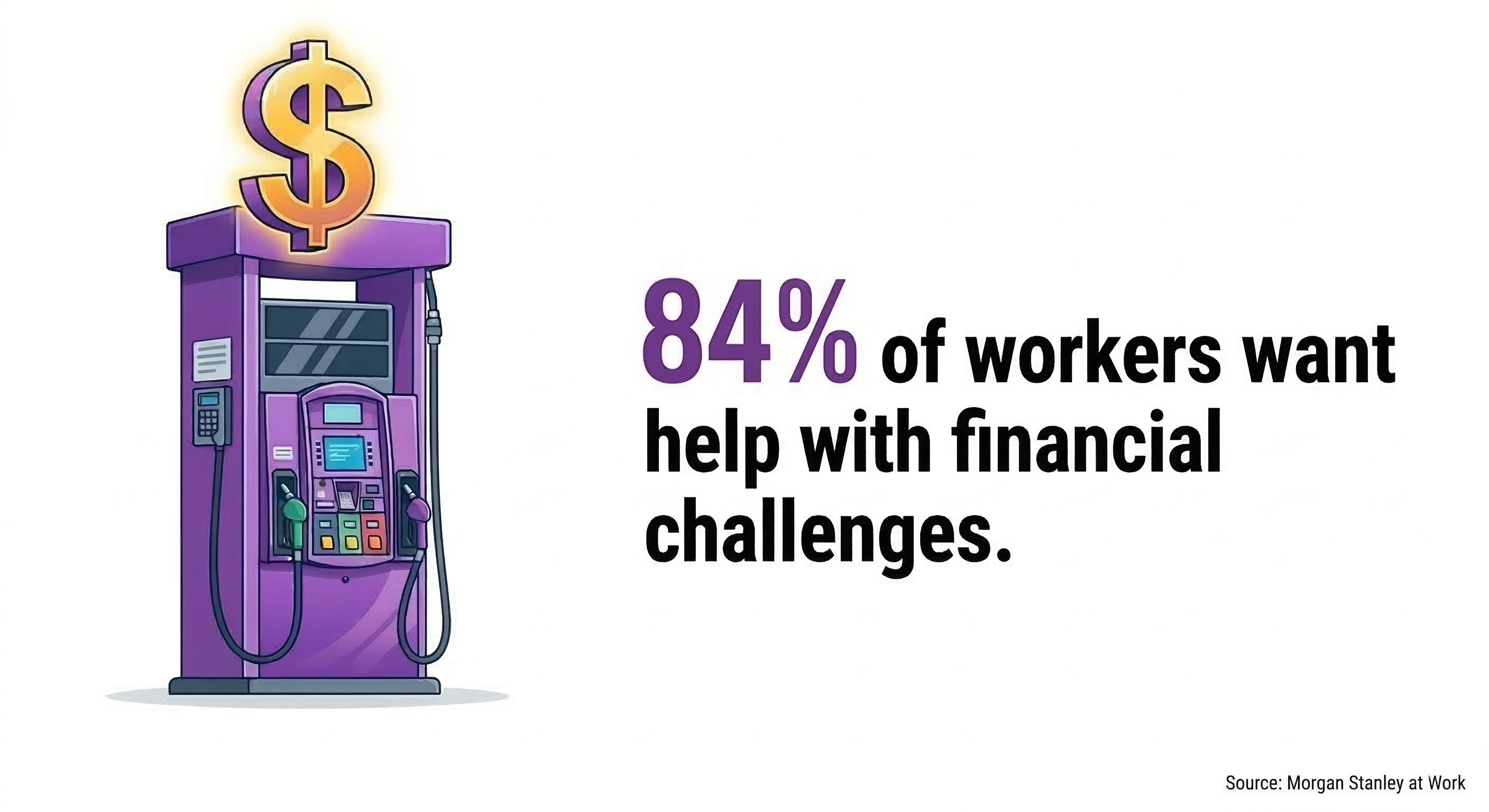
Gas pump prices rising with statistic demonstrating employee request for help with financial challenges from employers.
Visualization created with AI assistance based on original reporting.
  • Key insight: Discover how commuting-cost pressure is reshaping employer benefits strategy and retention tactics.
  • Expert quote: Offer deeper financial education and planning tools — immediate and long-term levers, says Kate Winget.
  • Supporting data: 84% of workers — and 95% of Gen Z — want employers to increase financial support.
    Source: Bullets generated by AI with editorial review

Processing Content

Financial stress is hitting a new high for employees thanks to the fallout of climbing fuel prices. Benefit leaders can ease the impact by reminding them about helpful offerings and reassessing flexible work and commuting policies.  

Gas has gone up an average of 71 cents per gallon and diesel has seen an even sharper climb since the U.S. entered into a military conflict with Iran in late February, according to AAA. In addition to increased commuting costs, experts warn this will lead to higher prices for other essentials, such as groceries, that require transport. With the majority of Americans already living paycheck to paycheck, these changes are due to hit employees and their families hard, and they're looking to employers for help.    

A 2025 survey by Morgan Stanley at Work found that 84% of overall workers — and 95% of Gen Z — think their employer should play a more active role in helping them manage financial challenges. Now is a great time to answer the call, says Kate Winget, the company's chief revenue officer.  

"With the macro conditions that everyone's seeing, there's always the question of what's around the corner," she says. "Making sure you are providing deeper-dive education of what benefits are available to employees in the financial space — even bringing in financial planning solutions [like] budget and savings tools, digital and on site — [can be a] lever for the future, but also the lever for now."

Read more:  Nearly half of U.S. workers say they're workaholics, survey finds 

A time for benefits to shine

Winget points out the importance of both general and demographic-specific efforts: Offerings such as tax guidance, company equity options and savings tools can be appealing to everyone in the workforce, while child care and eldercare benefits for working caregivers and student loan repayment options for borrowers can be more targeted. 

She also urges benefit leaders to train their organization's managers on the financial benefits available, so they can deliver valuable reminders to their teams. When employees are stressed about money, they may start to look for bigger paychecks elsewhere; enhanced communication that promotes benefits understanding can make the difference in them choosing to stay, she says.  

"Uncertainty opens up the question of making job changes over small dollars," Winget says. Equipping leaders to speak with their team members about benefits is another way to build  appreciation for a company's overall compensation package, she explains. 

Read more:  As AI boosts collaboration, employees resist office mandates

Flexible work and commuting options to consider

Along with financial benefits, employers can consider a temporary reduction of in-office hours as well as alternative commuting options to help employees cut down on daily spending. Nisha Mokshagundam, program manager at Way to Go, a free Denver-based platform that specializes in helping organizations create efficient transportation plans, says benefit leaders can design cost-efficient choices that have employer advantages, too.   

"Allowing your employees to shift their commute outside of peak travel hours lets them get to work faster and with a more positive mindset," she says. "If you're near a transit center … invest in transit passes for employees … to get to work. Additionally, offering unlimited passes … which allows staff to freely use transit outside work hours to get to games, concerts and other events … is a relatively low-cost option for employers to improve their benefit offerings." 

Benefit leaders can motivate employees to use sustainable transportation or explore carpool options with coworkers with cash or other incentives, Mokshagundam says. If driving can't be avoided, employers can also look at commuter stipends and sponsored lunches to provide meaningful savings.  

Read more:  2026 Excellence in Benefits Awards nominations are now open

By arming employees with education and supportive offerings, benefit leaders can take the immediate sting out of financially trying times and build long-term ties between workers and the company, says Winget.   

"Think about important benefits that your team or your business unit should take advantage of," she says. "The cost of living is going up. A very well-rounded dialogue can happen between benefit leaders, front-line managers and employees themselves. By having these conversations, you might be able to save employees from moving on."


For reprint and licensing requests for this article, click here.
Financial wellness Employee benefits Compensation Industry News
MORE FROM EMPLOYEE BENEFIT NEWS