- Key Insight: Discover how pay, career paths and flexibility jointly drive 2026 employee mobility.
- What's at Stake: Companies risk talent loss and competitive decline if rewards strategies remain static.
- Supporting Data: One in five employees plan to switch jobs; 42% are passively looking.
- Source: Bullets generated by AI with editorial review
Higher pay is the biggest driver pushing employees to switch jobs in 2026, but employers say applicants' salary expectations are outpacing what they can offer.

A new report from Clarify Capital outlines some of the themes that are expected to dominate an
"It's pretty telling that a possible threat of turnover is very real given the circumstances in the market," Michael Baynes, CEO and co-founder of Clarify Capital, said in an email response to questions. "Of course, the flip side of this is that 45% of HR leaders also say they're hiring."
Clarify Capital's report, which surveyed both employees and HR professionals, also highlighted the skills that employers are looking for: Customer support (23%), AI/machine learning (23%), and soft skills (22%).
Read more:
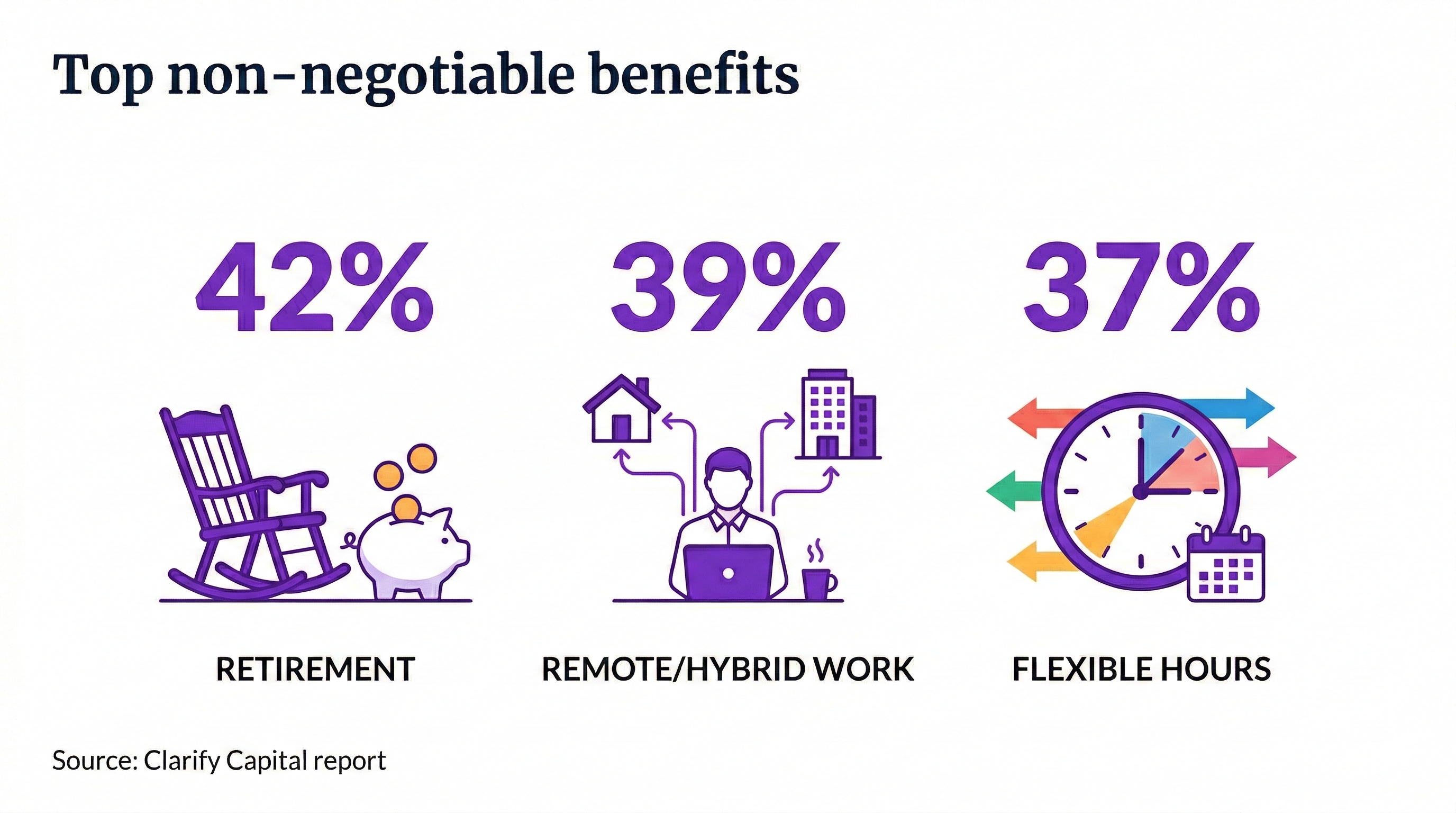
Beyond pay, employees can still be swayed by competitive benefits, according to the report. When looking for a job, employees said that the top non-negotiable employee benefits are retirement (42%), remote/hybrid work options (39%) and flexible hours (37%).
Read more:
Baynes talked about these trends and more in a recent interview with Employee Benefit News. This interview has been edited for length and clarity.
What role do training and career development benefits play in retention strategies?
Career development has clearly shifted from being a "nice to have" to being a "must have" in today's job market. When we looked at the data, we saw that 33% of job seekers say that training and career development benefits are non-negotiables. What really speaks volumes to employees eyeing their exit is that 41% say they're calling it quits on their employer mainly because they want better career development opportunities. So clearly it's more than money; it's about professional growth and not hitting your head on the ceiling.
What does your data tell you about the increasing significance of flexibility in total rewards?
Flexibility is no longer a want for workers — it is a must have. Thirty-four percent of HR leaders say they've lost a top candidate
What is the role of career development in an employee's decision to stay or leave?
One thing that's imperative for today's workers is career stagnation. For 41% of employees, the grass is greener on the other side, since they're saying they have
How do small and midsize organizations compete with larger ones on employee benefits?
It can be difficult for small and midsize organizations to realistically compete with the salaries of larger corporations. Flexibility, career development and clearly defined career paths are the solution. It is about positioning themselves well against the larger corporation. The good news is 67% of HR leaders are confident they can find qualified talent.
What can be concluded about job security? Are people feeling more secure in their jobs, or is the fear of layoffs continuing to play a role?
Job security is a fickle thing in 2026. You have 64% of job seekers feeling confident they'll find something better. Meanwhile, more than one in four are actively looking for a new job because their
What recommendations would you make to HR leaders to ensure their organizations remain competitive through 2026?
It is definitely time to reevaluate pay scales since the pressure doesn't show any signs of slowing down. Next, organizations need to define career paths since employees do not always understand how they are progressing. Then there is the issue of flexibility since organizations are losing talent due to remote work limitations. Finally, organizations need to streamline their recruitment process. Twenty-six percent of HR leaders say there are too many unqualified applicants.
If you had to pick just one defining trend that will shape the 2026 job market, what would it be and why?
If I had to nail it down to one, it would be intentional mobility. The days of casual browsing for a new job are declining, and people are actively considering pay, career paths, flexibility and security simultaneously.