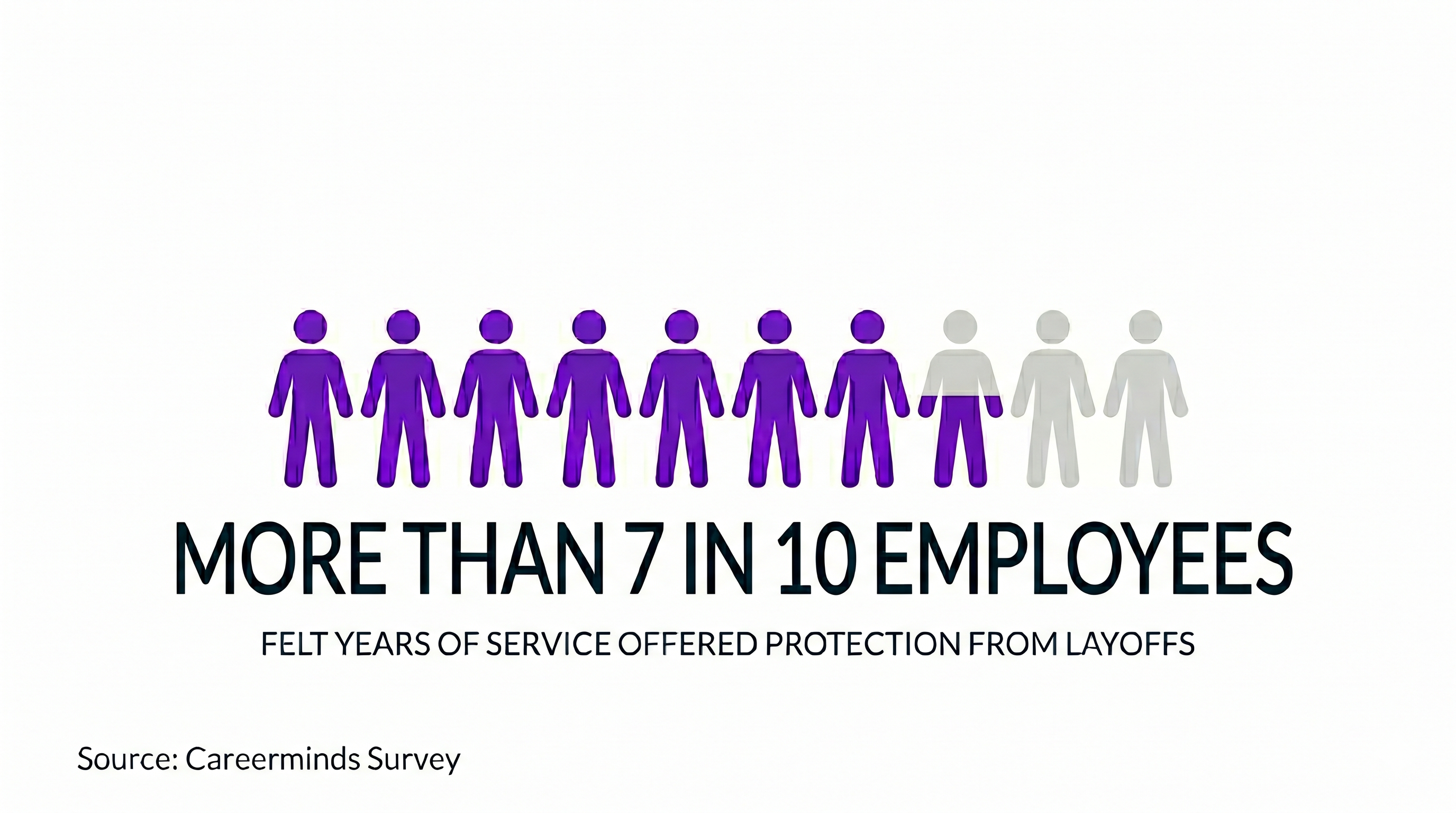
- Key insight: Discover how the "loyalty tax" leaves long-tenured workers professionally unprepared.
- Expert quote: Don't let tenure stall proactive career management. - Amanda Augustine, Careerminds.
- Supporting data: Survey of 900: over 70% believed tenure guaranteed job security; 66% had little warning.
Source: Bullets generated by AI with editorial review
Long-tenured employees often believe they're protected from layoffs, but
In a survey of 900 people who had been laid off by an employer they'd been with for five or more years, more than seven out of 10 said they thought their years of service would keep them safe and 66% felt they had little to no warning before being let go.
The research, conducted by workforce solutions firm Careerminds, highlighted what has been dubbed the "loyalty tax" — when employees' sense of job security renders them
It's a scenario Amanda Augustine, a certified professional career coach and resident career expert at Careerminds, has seen a lot since the uptick in layoffs this year. "As much as someone like me can preach that you should always be looking [at other opportunities], always be keeping your materials up to date, have a brag book where at least once a quarter you're updating your great accomplishments and things like that, the reality is if somebody feels very secure in their role, they're probably letting that slide," she said.
Aside from the practical concern of having to find another job, being laid off after years of service takes an emotional toll, Augustine said. "It feels like an assault to the individual affected, because there's this sense of an unspoken trust or agreement being broken." Fifty-one percent of Careerminds' respondents said it took them more than six months to emotionally process being laid off, and nearly 60% are less loyal to employers in general due to their experience.
To help laid off workers get their professional history up to date and feel supported in their search for a new position, organizations can offer outplacement solutions as part of a severance package — an employer-covered career transition service that provides workers with re-employment skills.
Read more:
The value of outplacement
Outplacement includes services such as resume and cover letter writing assistance, career coaching, interview and salary negotiation practice, and networking, according to human capital management platform ADP. Employers can offer this through a third party vendor such as Careerminds as part of a severance package, and pick and choose what services are included. In addition to these traditional services, Augustine emphasized the need to include upskilling and reskilling in AI skills so job seekers are viable in a market full of evolving tech.
"Roles themselves are evolving to require different skills … so it's important to ensure that outplacement isn't just getting their resume prepared and prepping them for interviews, but also helping these individuals upskill and reskill," she said. "Even if they're going to try and make a lateral move, they may not be set up for success with the existing skills that they have, and that's an important part of it — making sure they're set up for success."
So that people's resumes, cover letters and LinkedIn profiles can be updated properly, Augustine notes the importance of giving them the time and resources to pull important output metrics and details about their accomplishments from their time with the company.
"Your current resume typically holds the most recent 10 to 15 years of your work experience, so if you haven't had to look for a job in 10 years, chances are the vast majority of your resume is obsolete, and you're starting from scratch," she said. A good amount of advanced notice — months, not weeks — also "gives them time to process it and to begin preparing for that job search while they still have a paycheck coming in," she added.
Read more:
Layoffs' wider impact
The way layoffs are handled doesn't just impact employees being let go — it affects those who remain as well as the brand itself. Airbnb's 2020 layoffs of 1,900 workers is often cited as an example of best practice: In a letter to all workers, CEO Brian Chesky outlined the reasons for layoffs and U.S. employees' severance package — 14 weeks severance plus one week per year of service, 12 months of healthcare, shareholder equity for anyone departing, job support resources including internal and external placement help, and the ability to keep their work-issued laptops. In an article about the announcement, Forbes referred to Chesky's actions as "a master class in empathy and compassion."
In contrast, when Twitter laid off thousands of employees in 2022, some were locked out of their company email and communication platforms before the layoffs were announced, according to CNN. A class action lawsuit was later filed alleging insufficient termination notice under the California Worker Adjustment and Retraining Notification Act. The article included a tweet from one laid-off employee who posted, "Just got remotely logged out of my work laptop and removed from Slack. So sad it had to end this way." Shortly following the layoffs, internal estimates revealed at least 1,200 employees had resigned, according to an article by the New York Times.
CNN reported that Twitter's eventual severance offer "included one month's pay in exchange for agreeing to various terms, including a non-disparagement agreement and waiving the right to take any legal action against the company, according to Lisa Bloom, a lawyer representing dozens of former Twitter employees affected by the layoffs."
Read more:
Treating departing employees with respect and offering benefits and resources to help them find their next role isn't just the right thing to do — it's good for the remaining workforce's morale, Augustine said.
"How you release and support employees during the transition out of the organization is key, and really does leave a lasting impression," she said. "Your remaining employees see how you treat the employees who are exiting, particularly those who are incredibly loyal to the organization. It signals to the rest of your workforce how you treat and how you value the contributions of your employees [in general]."