Getting close to retirement? Here are 6 key considerations
Employees who plan to retire next year should ensure they have enough savings to cover their healthcare expenses before making a decision.


Follow Us
© 2026 Arizent. All rights reserved.

Employees who plan to retire next year should ensure they have enough savings to cover their healthcare expenses before making a decision.
Despite Social Security's financial woes, the revenue shortfall can be easily fixed, say experts at Boston College Center for Retirement Research. But it will only go so far in paying for living expenses.
Failing to take the mandatory distribution on time may push retirees to a higher tax bracket.


Lower-earning spouses who took time off to raise children or care for an aging parent may not be eligible based on the taxes they paid into the system.

Some people have a hard time getting their one-time pass code to log on to their My Social Security account.
Many of the bill’s provisions are taken from the Retirement Enhancement and Savings Act, which enjoyed some bipartisan support.

The years between 60 and 70 present a great opportunity for seniors to make moves to protect their retirement savings.
Older couples should determine whether they are physically ready for the task, as moving can be stressful for people of advanced age.

Workers should consider contributing enough to their 401(k) plans to get their employer's match before making contributions to an IRA.

Beginning in January, employees can save up to $19,000 in their 401(k)s, up from $18,500.

Reinventing a new life may involve uncovering new interests and a new way to live after you leave your career.

In addition to health insurance considerations. people considering this need to determine whether they can afford the missed earnings and the ability to continue building their nest egg.

Someone who starts saving from age 20 can sock away 90% less per month than someone who gets a later start at age 50 and still build the the same size of portfolio.

Employers should inform their workers about the benefits of increasing their 401(k) contributions and investing in health savings accounts, among other tips.

The guideline used a specific set of assumptions: a retirement lasting 30 years with savings in a tax-deferred account and nothing left for heirs. Change just one and your “safe” withdrawal rate may differ.
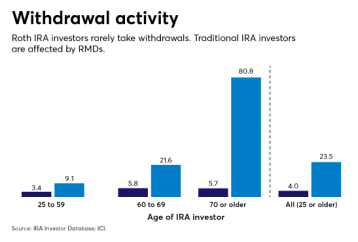
Lawmakers are looking to pass the Retirement Enhancement and Savings Act of 2018, which will allow workers to save more while encouraging employers to offer more retirement savings options.

The president plans to issue an executive order Friday to make it easier for small businesses to band together to set up retirement-savings plans.

Millennials and other younger clients would see their Social Security benefits decrease 21% once the program runs out of funds by 2034.

Many single baby boomers opt to stay put in retirement because they have no children who would advise them to move to an assisted living or continuous care community.

Seniors are likely to be in a lower tax bracket in the few years after retirement, creating a "sweet spot" for them to convert some of their traditional 401(k) or traditional IRA assets into a Roth account.
