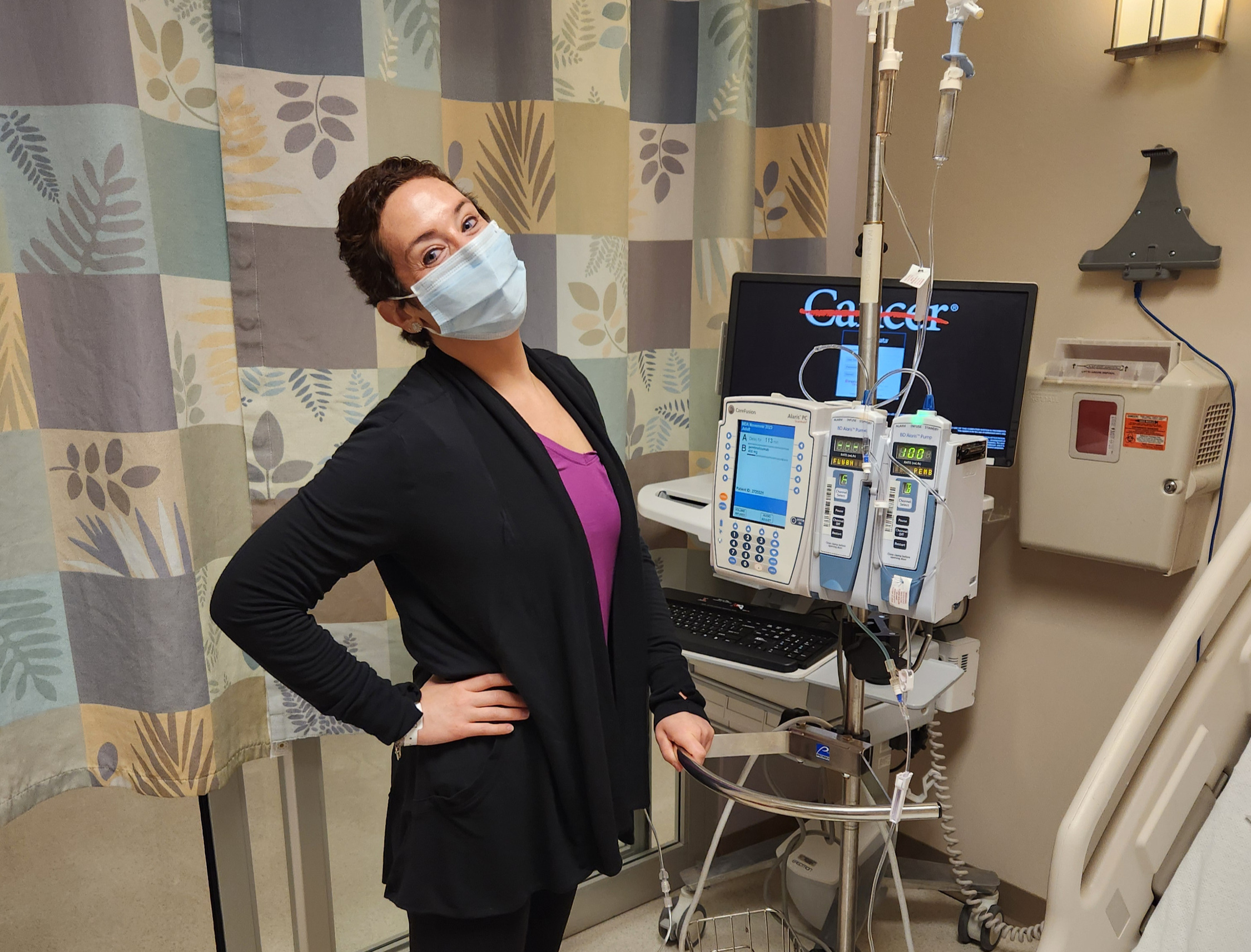
- Key insight: Learn how an employee's cancer experience redirected employer benefits design.
- Quote: Benefits must be humanized; employees need accessible, empathetic guidance. — Jessica Domann
- Supporting data: Phillips added Color Health cancer screening and genetic testing to its HDHP and PPO plans.
Source: Bullets generated by AI with editorial review
"You're young, you're healthy, it's nothing to worry about."
Benefits adviser Jessica Domann recalls these
Her results would change her world — and how she designed cancer support for her company.
Two days after the biopsy, Domann was diagnosed with triple negative invasive ductal carcinoma — the most aggressive form of
"We have a [healthcare navigation] benefit called Included Health that I could have contacted and said, 'Here is my situation. I'm in Houston. I have one of the top cancer hospitals in the world eight miles from my house. Can you get me in?' And they would have done that," she explains. "But the moment you become a patient, every amount of logic and reasoning and the tools and resources that you know you have just go out the window."
Read more:
Becoming a benefits "guinea pig"
Throughout 2023 and 2024, Domann went through chemo, a lumpectomy and reconstruction, radiation, and immunotherapy, all while figuring out necessary benefits, such as an accommodation to work from home, employee health reports, short-term disability and FMLA, approval for medications, post-surgery garments and a wig, and how to process a claim and appeal if it's denied.
She quickly realized that if these things were challenging for her, a benefits expert, other employees would surely struggle.
"I was our guinea pig in a lot of ways," she says. "We have a very robust, rich benefits ecosystem, but then you use it in a way that none of us had before, you learn things," she says. "It's the little things — documents and language that you just don't pick up on unless you're looking for it. Our employees are not reading our summary plan description unless we spell it out for them."
Read more:
Streamlining navigation and prevention
Domann worked with her team to build a
She also connected with Phillips' Diverse Abilities Network employee resource group to add coworkers with cancer — which is covered under the ADA — to their support network, and helped organize company-wide events including a cancer prevention fair and an In Their Shoes presentation, where she shared her experience.
At the start of 2026, Phillips added cancer screening and treatment support platform Color Health to its HDHP and PPO plans, giving its nearly 12,000 U.S. employees access to at-home screening tests for certain cancers, genetic testing for hereditary cancer risk, and end-to-end concierge support for patients, survivors and caregivers. It also helps with communication about the benefit, which has even included in-person visits by Color representatives to Phillips' on-site health clinics located at its refineries and headquarters.
"[Employees and their dependents] need to know what this cancer screening benefit is, they need to be able to see it, and they need to be able to do it at home. If it's hard to access a primary care physician in a healthcare desert, at least it gives you a chance to go through an assessment and see what you need to be doing," she says. "And because they also support people as a patient, survivor or caregiver, it's that whole spectrum of cancer that needs to be addressed but is often forgotten."
Read more:
The power of a second opinion
Following her original rounds of treatment, Domann was given an all-clear of invasive cancer cells in her tissue. Through Included Health, she has access to a second-opinion benefit, which she utilized for advice about the proper ongoing scan surveillance. The oncology expert she worked with recommended getting more frequent scans — which led to the early detection of her cancer's recurrence last November.
"There is a 1% to 2% chance that [my specific cancer] would return. The reason it didn't spread further is because the Included Health second opinion gave me advice to request more surveillance, or I would have waited another six months."
Domann rang the bell for treatment conclusion in early April, and is scheduled for another, more intensive surgery in May. Meanwhile, she is devoted to using her benefits role as a platform for promoting screenings, encouraging employees to advocate for their health and improving their understanding of benefits.
"Sometimes the voice that you get your benefits information from is the voice that makes you take action," she says. "If you get just one more email in your inbox, how seriously are you going to take that? Are you going to listen, or are you more likely to listen to a person that has a relatable story and a face you can see?"
Domann advises other benefit leaders to find a way to bring a human voice to their employees as well. "You have to humanize things that might be scary. We can't just look at something like cancer from a high-cost claimant, high spend perspective," she says. "Yes, cancer is very expensive, but that money is going towards truly saving somebody's life, and that someone has a spouse, children and friends who love them, coworkers who sit next to them, and they need that level of human touch and a little empathy that I think a lot of workplaces lack."
Read more about the challenges and solutions in cancer benefits:
Employees are living with cancer but their benefits are failing them Aflac's Check for Cancer campaign is a call to action for employers Hot Topic, Color Health streamline access to cancer screening Why UnitedHealthcare expanded its cancer prevention benefits How this AI platform is improving low-cost access to cancer care