It takes a village — but as parenting support fades, employers are asked to step in

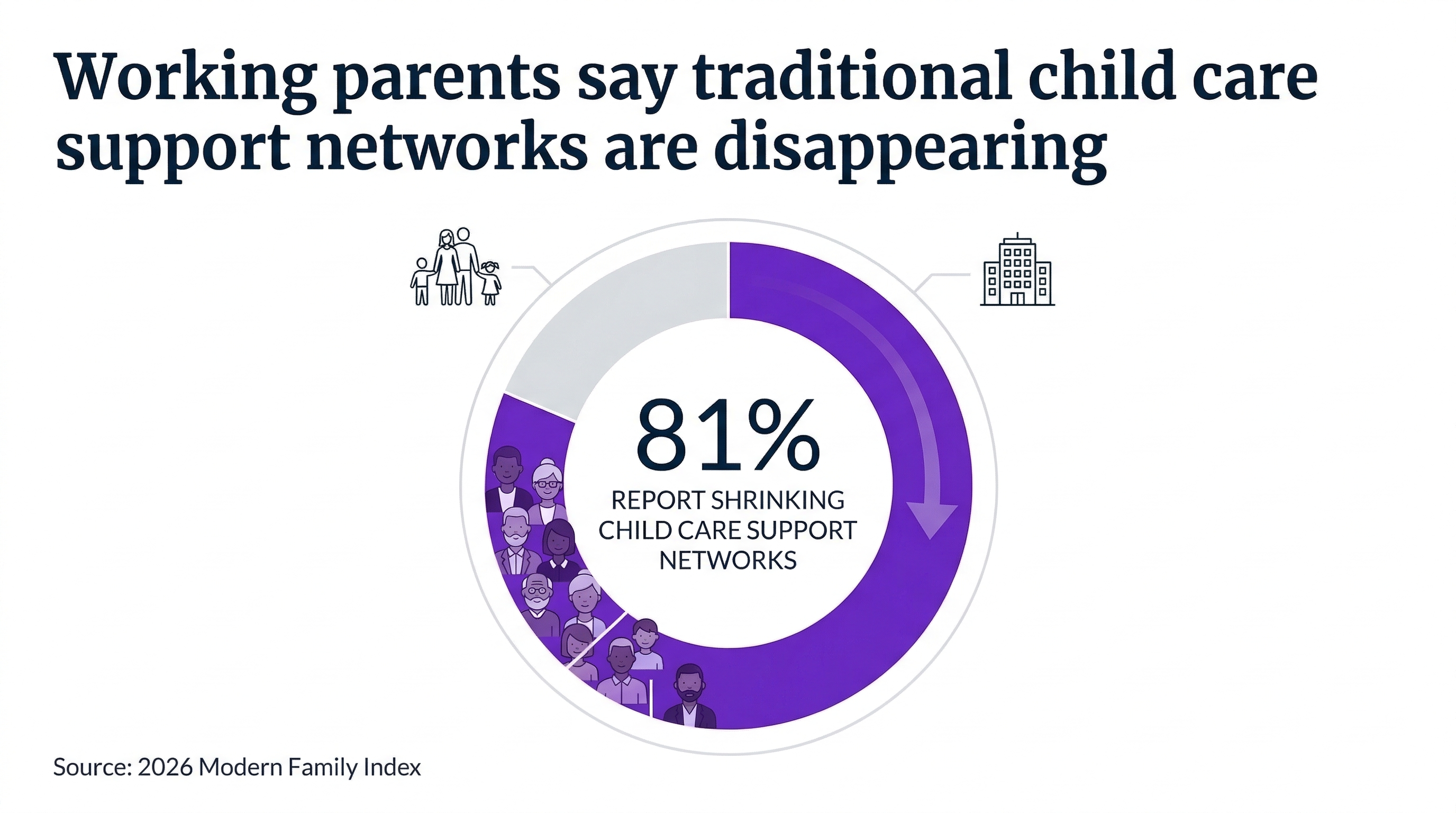
Circular infographic showing 81% of working parents reporting shrinking child care support networks.
Visualization created with AI assistance based on original reporting.
  • Key Insight: Discover how the disappearing "village" shifts caregiving obligations onto employers.
  • What's at Stake: Shrinking informal care creates retention, productivity and compliance risks for employers.
  • Supporting Data: Average annual full-time child care ranges $6,552–$15,600 per child nationwide.
    Source: Bullets generated by AI with editorial review

The traditional "village" that helped generations of working parents raise their kids is disappearing, putting a strain on families and the employers who rely on them. 

The 2026 Modern Family Index shows that household dynamics have shifted, adding to the stress that many parents feel amid rising child care costs. Eighty-one percent of working parents say the number of people they can depend on to help with child care during their workday has shrunk compared to previous generations. 

Processing Content

Yet 77% agree that raising children requires a village, according to the research study, which was commissioned by Bright Horizons Family Solutions and conducted by The Harris Poll. 

This trend creates an opportunity for employers to step in and provide more child care support for working parents, says Priya Krishnan, chief digital and transformation officer at Bright Horizons. 

"That village is really disappearing, and those responsibilities are falling on working parents," Krishnan says. "If you want parents to be happy, healthy and productive at work, then providing these supports is something that employers need to continue to do."

Working parents surveyed noted the difficulties in arranging child care during office hours, with many feeling at the mercy of others or burdened by guilt for having to ask for help. Sixty-three percent want more reliable, formal care for their children during the workday, while 65% want their employer to play a larger role in their parenting village by providing resources to support child care.

Read more: Can employers solve the child care crisis?

For many families, paying out of pocket for child care is out of reach. The average annual cost of full-time care per child ranges from $6,552 to $15,600 nationwide, according to the U.S. Department of Labor's most recent data.

Sixty-two percent of working parents say finding other people to watch or care for their children during the workday is more difficult than they expected, and 56% are constantly stressed about what they would do if their regular child care fell through or was unexpectedly unavailable during the workday.

Additionally, 25% are currently providing unpaid care for an older parent or relative, adding stress and responsibilities to their already full plates.

"As the needs of working parents continue to evolve, they deserve dependable care solutions that allow them to thrive both at work and at home," Bright Horizons CEO Stephen Kramer said in a press release. 

What's causing the village to disappear?

Krishnan says several factors have caused the traditional village that once supported families to erode. Many people today have less time to help watch their relative's kids, and the makeup of neighborhoods has changed over the years because of migration.

The rise of hybrid work has also had an impact, with parents scrambling to coordinate pickups, after-school programs and other activities while balancing job duties. 

When the traditional village falls apart, Krishnan says, parents lose access to a trusted source of care that oftentimes comes at no cost, and the burden ultimately falls entirely on their shoulders. This is where employers have an opportunity to help fill the gap. 

"Employees are saying, 'If you want me to turn up and be productive at work, we need you to help you with these things," Krishnan says.

Bright Horizons partners with more than 1,400 organizations to support their employees with care solutions such as on-site centers, access to community centers, and elder and pet care assistance. 

One of those organizations is The J.M. Smucker Company in Orrville, Ohio., which opened an on-site child development center in 2014. The center has a capacity of 110 and provides care for children from infancy through school age, including drop-in services for kids up to 12.

Read more: Child care surpasses retirement as top work perk

"The Center has been a wholly positive addition to our campus and our ability to meet the needs of employees," a spokesman for J.M. Smucker said in an email. "We know it plays a role in recruitment and retention but, most importantly, that it continues to meet the needs of our employees and their families."

When companies like J.M. Smucker offer child care benefits, it takes a cognitive load off of parents and helps them be more present in the workplace, Krishnan says. 

"Caregiving is at the core of mental well-being," she says. "If I can care for the loved ones that I have, I turn up and I'm productive at work and that helps the employer."


For reprint and licensing requests for this article, click here.
Employee benefits Health and wellness Workplace culture Hybrid Work
MORE FROM EMPLOYEE BENEFIT NEWS