Rising health costs outpace Social Security for retirees 

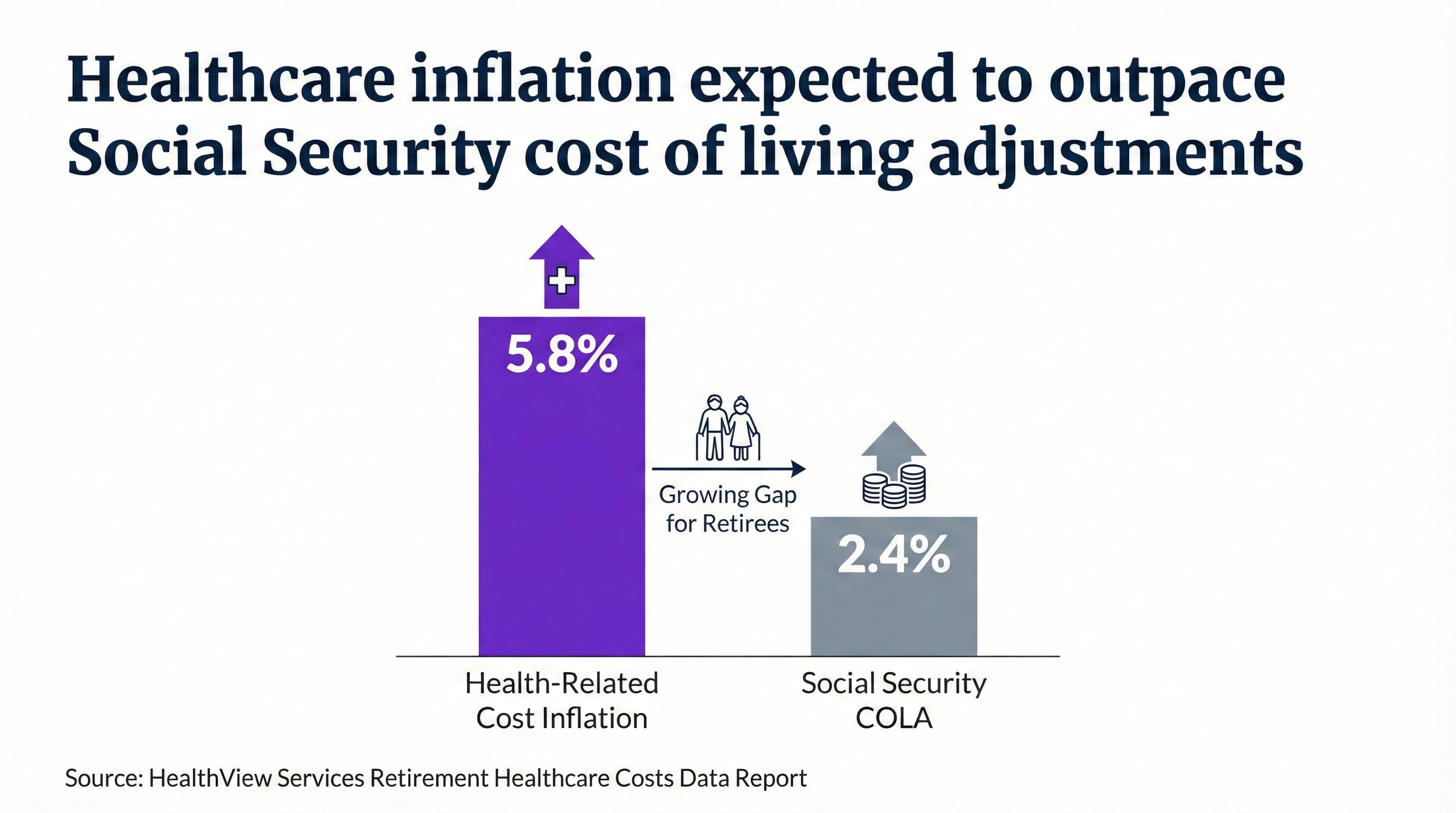
Bar chart shows 5.8% healthcare inflation outpacing 2.4% Social Security COLA, creating a growing gap for retirees.
Visualization created with AI assistance based on original reporting.
  • Key Insight: Learn why health-cost inflation is outpacing retirement income growth, reshaping retiree budgeting.
  • What's at Stake: Rising retiree medical spending could strain employer benefits and public program sustainability.
  • Supporting Data: Health inflation projected 5.8% versus Social Security COLA 2.4% annually.
  • Source: Bullets generated by AI with editorial review

Inflation will continue to drive up healthcare costs for retirees, despite legislative efforts to stem rising expenses, according to a new report.

HealthView Services outlines the many challenges that retirees are expected to face when budgeting for medical expenses. One of the biggest issues, the report points out, is the growing difference between the long-term inflation rate for health-related costs and projected Social Security cost of living adjustments. 

Processing Content

Social Security COLAs are expected to rise 2.4% annually, but health-related cost inflation is forecast to remain stubbornly high with a rate of 5.8%. That gap means retirees will need a growing portion of Social Security benefits to cover expenses. 

"After a decade of publishing these data reports, the cost of health-related care in retirement still comes with sticker shock," says Ron Mastrogiovanni, CEO of HealthView Services. "The report serves as a somewhat chilling reminder of the limited impact of legislative changes to reduce the burden of these costs."

The Retirement Healthcare Costs Data Report also highlights the rising cost of Medicare programs: Medicare Part B (medical insurance) and Medicare Advantage premiums directly deducted from Social Security increased by 9.7% for 2026, and the national average Medicare Advantage inflation rate was 6.6%.

Additionally, premiums for Medicare Part D (drug coverage) have increased by 50% since the passage of the Inflation Reduction Act in 2022, which reduced the cap on catastrophic prescription costs. 

What's driving up the costs?

There's no one answer as to why healthcare costs keep climbing, says Mastrogiovanni. The providers blame the insurance companies and drug manufacturers, while the insurance companies blame the drug manufacturers and hospitals systems. 

But one fundamental problem, Mastrogiovanni says, is that many hospitals are essentially operating near break even. 

Read more: Employees are turning 65 with no plans to retire: What this means for benefits

"You have a number of people who don't have any insurance, and they can't pay but still have to be cared for," Mastrogiovanni says. "Then you have the group on Medicare. They typically pay more than people who don't have anything, but they pay less than those who are insured through an employer. 

"So what ends up happening is the employers typically get hit the hardest in terms of coverage, especially the smaller employers, because that's where the hospitals can generate more money." 

HealthView's report also calls attention to the importance of taking key variables such as health condition, income, state of residence and gender into account when planning for medical expenses in retirement. Lifetime costs vary greatly by state: the report points out that a couple living in Missouri could pay as much as $1,053,252, while in Washington state those same services would cost $878,565. 

Income is another important factor — Medicare's Income-Related Monthly Adjustment Amount policy determines how much recipients pay for Medicare Parts B and D. In effect, the higher a retiree's income, the greater their premiums for Medicare coverage. 

Planning for retirement

Benefit leaders can help employees plan for retirement by promoting helpful tools, such as a health savings account or Social Security optimization calculator, Mastrogiovanni says.

Individuals and families should aim to max out their annual HSA contributions and pay out-of-pocket for medical expenses, Mastrogiovanni says. This approach allows them to invest their HSA funds and earn compound interest over time.

Read more: Health savings accounts gain popularity as investment vehicles

Social Security optimization calculators can be especially helpful for retirement planning because they can help people see how the timing of their claim affects their lifetime income. They factor in elements like life expectancy, spousal benefits, survivor benefit and projected benefit growth. 

"Those are important numbers to know," Mastrogiovanni says. "I think this is an area that HR should be more focused on because it really helps people, especially families with young kids." 

For reprint and licensing requests for this article, click here.
Retirement Financial wellness Employee benefits Compensation
MORE FROM EMPLOYEE BENEFIT NEWS