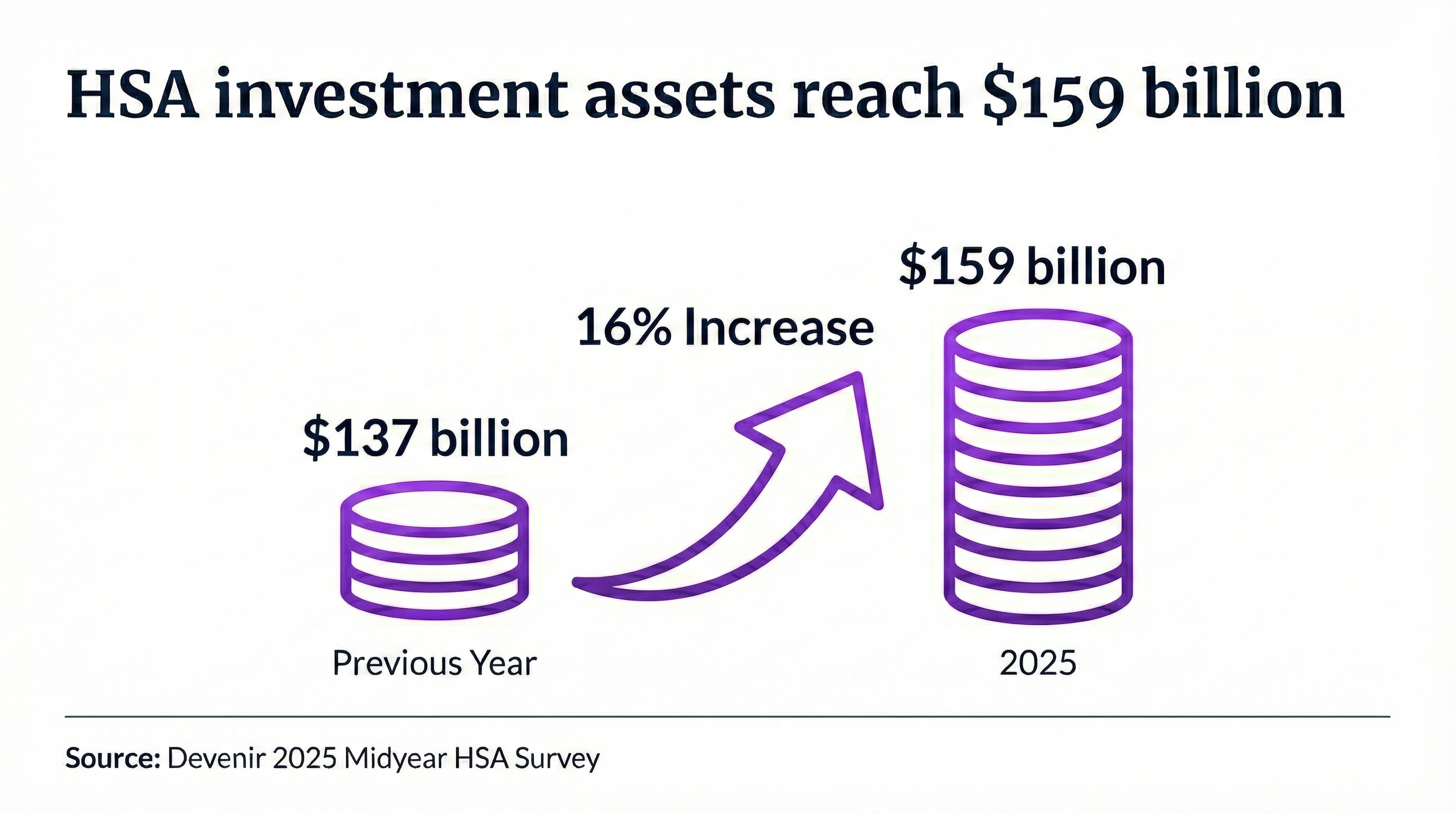
- Key Insight: Discover how increasing HSA investing repositions accounts as long-term healthcare savings and investment vehicles.
- What's at Stake: Employers face engagement shortfalls and potential future cost exposure if HSAs remain underutilized.
- Forward Look: Expanded eligibility under recent legislation may add 3–4 million participants by 2027.
- Source: Bullets generated by AI with editorial review
More Americans are putting their HSA dollars to work through investments, a move experts say could make it easier to cover the medical bills that come with getting older.

Around 4 million HSAs — roughly 10% of all accounts — held at least some of their HSA dollars in investments at the middle of last year, according to the Devenir 2025 Midyear HSA Survey. That represents a 23% year-over-year increase.
"HSAs saw strong growth in the first half of 2025, driven by steady contributions and market gains," Jon Robb, senior vice president of research and technology at Devenir, said in a press release. "More account holders are choosing to invest, while many households still use HSAs for current medical costs. That dual role, both spending account and long-term savings vehicle, continues to drive the popularity and growth of HSAs."
When HSAs were created by the Medicare Prescription Drug, Improvement, and Modernization Act of 2003, they were designed as long-term savings vehicles. But because of a lack of awareness and poor messaging, many account holders still don't invest their funds, says Nick DiMauro, consumer benefits expert and CEO of daylii.
Read more:
DiMauro says one of the biggest mistakes he sees "is consumers utilizing their card instead of paying out of pocket, saving those receipts and letting their money grow that compound interest."
Improving the messaging
Many HR leaders only
HSAs are governed by the IRS, so the rules and regulations surrounding the accounts generally remain the same year-to-year. But HR leaders can help employees make the most of their accounts by
"There's a lot of complexity around HSAs, and it's really important to take a uniformed approach for your employee group," DiMauro says. "It all comes down to education and making sure your HR directors understand these as well, because a lot of times they don't even understand it, so how are they going to communicate it to their employees? That's where it gets lost."
Read more:
More people are expected to sign up for HSAs in 2026 due to legislative changes. The One Big Beautiful Bill Act passed last year expanded eligibility for HSAs, making Bronze and Catastrophic Affordable Care Act plans HSA-eligible. According to the Morningstar 2025 Landscape Report, an additional 3 to 4 million participants could join the market.
"That's opening up HSAs to lower income families and Gen Z workers," DiMauro says.
With the expanded access, favorable tax advantages and growing need for healthcare savings, DiMauro sees
"I think this is an area that's going to grow pretty exponentially over the next decade," says DiMauro, who has called HSAs one of the most under-the-radar investment accounts in America. "They're an extremely powerful tool if used the right way, and I think it's just underutilized. It's a massive market."