- Key insight: Discover how data-driven benefits replace one-size-fits-all employee programs.
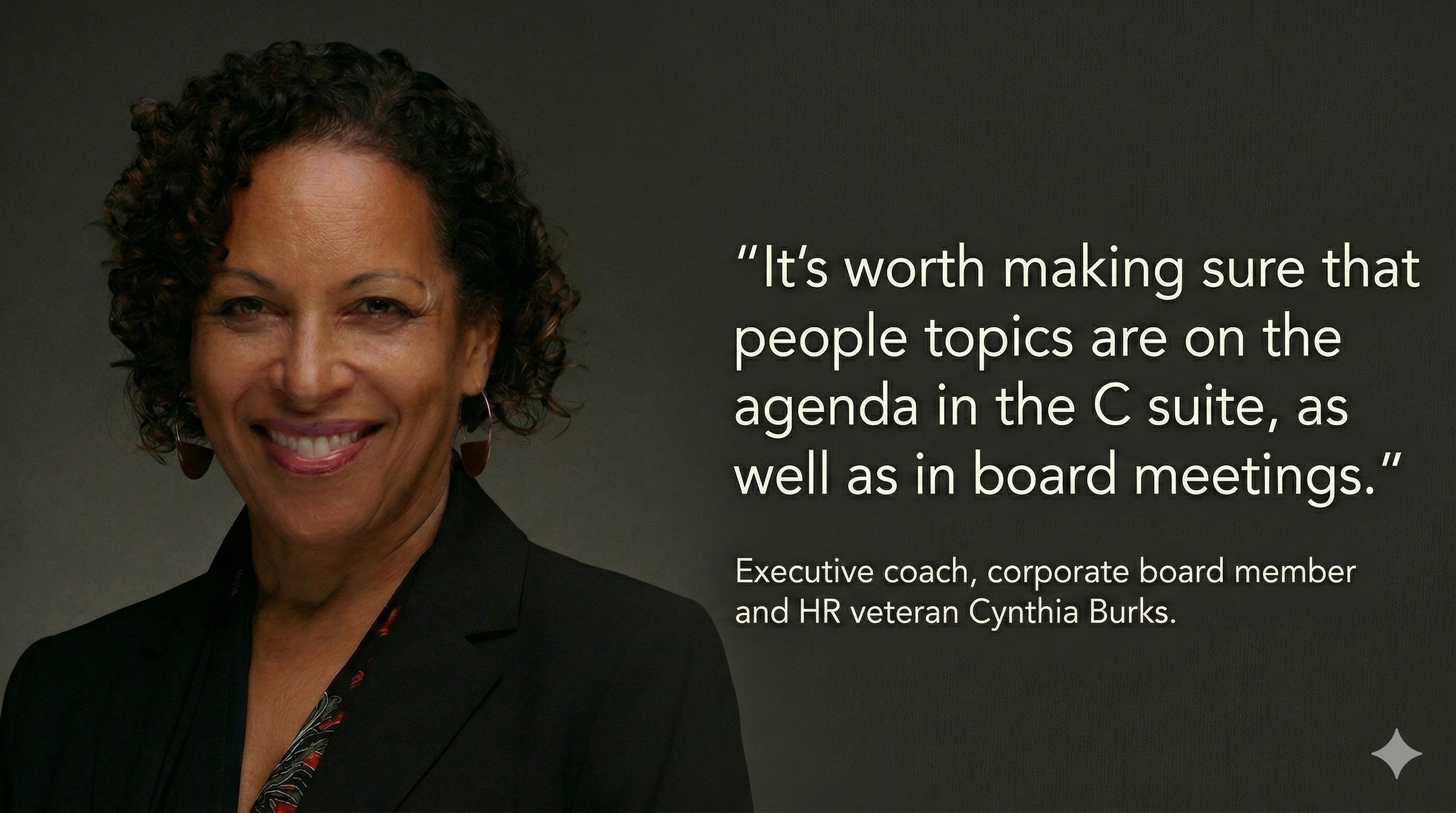
- Expert quote: Burks: HR must sit "at the table" while stewarding organizational culture.
- What's at stake: Misaligned goals risk reduced engagement, productivity, and competitive talent retention.
- Source: Bullets generated by AI with editorial review
As a girl, Cynthia Burks stood on union picket lines with her father while he and his fellow factory workers were on strike. There has to be a more effective way for employers to understand and
"I didn't really have the words for it at the time, but I grew up believing that there could be a better opportunity for employees and companies and management to engage with each other," she says.
Burks turned this mindset into a mission that shaped a 20-year HR career, helping company leaders
"[For a] company [to] thrive, you have to have an engaged and committed workforce," Burks says. "What is the work we should be doing to ensure that both the company and the employees are successful?"
Read more:
Developing a data-based benefits approach
Today, Burks relies on data to help communicate the value of benefits. It's a tactic she learned while CHRO of biotechnology company Genentech, where surrounded by scientists, she learned to approach leaders with the pragmatic perspective of, "What are we trying to solve, and what is the data that supports a solution?" The inclusion of facts and strategy creates better work, and it is more readily adopted, says Burks.
"When we were able to talk about the benefits for our employees using the language that our business leaders talked about in terms of meeting the needs of patients, it clicked differently," she says. "We talked about the fact that our patients aren't the same, so why would we think that a one-size-fits-all approach to benefits would work for our employees?"
Burks shares her top pieces of wisdom to HR leaders, how she hopes they will approach AI adoption, and how her current board roles help her to contribute to the success of organizations.
In your current roles as coach and board member, what are some of the key pieces of wisdom you pass on to HR leaders and other members of the C-suite?
One of the things that I typically talk about whenever I'm working with heads of HR is just acknowledging the unique space that position is in. As the head of HR, you're at the table as a business leader, but you also are the steward of the culture. You have a unique skill set, and you're in a unique position to see the entire organization.
The other thing that I like to talk about is that we're so focused on the organization and people that we often neglect our own development and our own care. [I make] sure that that is a priority in my conversations with the folks in HR, but also with the CEO.
It really is a collective responsibility, starting with the CEO, to make sure that they're engaged, that they have the resources they need, that they are in the loop with conversations and decisions and things that we're considering. I see the CEO as a person that needs to lead that, along with the rest of the C-suite.
Read more:
What is your advice to HR leaders who are seeing more technology, especially AI, integrated into their workflow?
We still don't know the full impact [of AI] and what that will do for work and different disciplines. In some respects, we should engage with the topic of AI in the same way we've engaged with other things that have propelled our discipline forward.
A few years ago, it was analytics. Data. Some people really were excited about it and embraced it. Others were resistant, because there was a concern that if we focus on analytics, that's taking the people out. We [now] know that analytics does not replace people, and I think in the same way, we should be at the forefront of deciding how AI can be leveraged in our organizations, and how it can be leveraged within our discipline.
So we shouldn't be waiting for someone to tell us. We should be moving into it, practicing, playing with it, feeling a little bit uncomfortable, thinking about the hard questions that need to be answered around governance as well as ethics around the use of AI, but we should be actively engaged and not shy away from leveraging it.
There's always this feeling of, gosh, there's so much more work that we know would be beneficial for the organization, but we don't have enough headcount. Knowing that this is a persistent issue, how can we as a discipline focus more on the things that have the biggest impact in our organizations, and then leverage AI or other technology to take care of some of the more routine or mundane things.
Read more:
As a board member, how do you encourage HR and benefit leaders to work more collaboratively with the C-suite and other stakeholders to make a positive impact?
We should be probing, asking questions, providing examples, really getting management to think holistically about what they're considering or what they're proposing or what they should be doing. Yes, we bring our expertise, but it should be presented and shared with management in the form of really great questions, versus telling them what to do.
The other thing we should be doing, especially, for example, as a member of the compensation or talent committee, is bringing in an outside perspective. [When I reflect upon being] a head of HR, there were times that I was so internally focused that I missed external data points, or sources or information that could have better informed whatever strategy I had, or solution I was proposing.
[By bringing in] an outside perspective, we can ensure that whatever is being considered has been thought through in a very holistic way — not just through the lens of the internal dynamics or organization. Those are the things that we can help benefit leaders or heads of HR think about as they think about their offerings for employees.