Workers feel financial stress at work, cut back on benefits

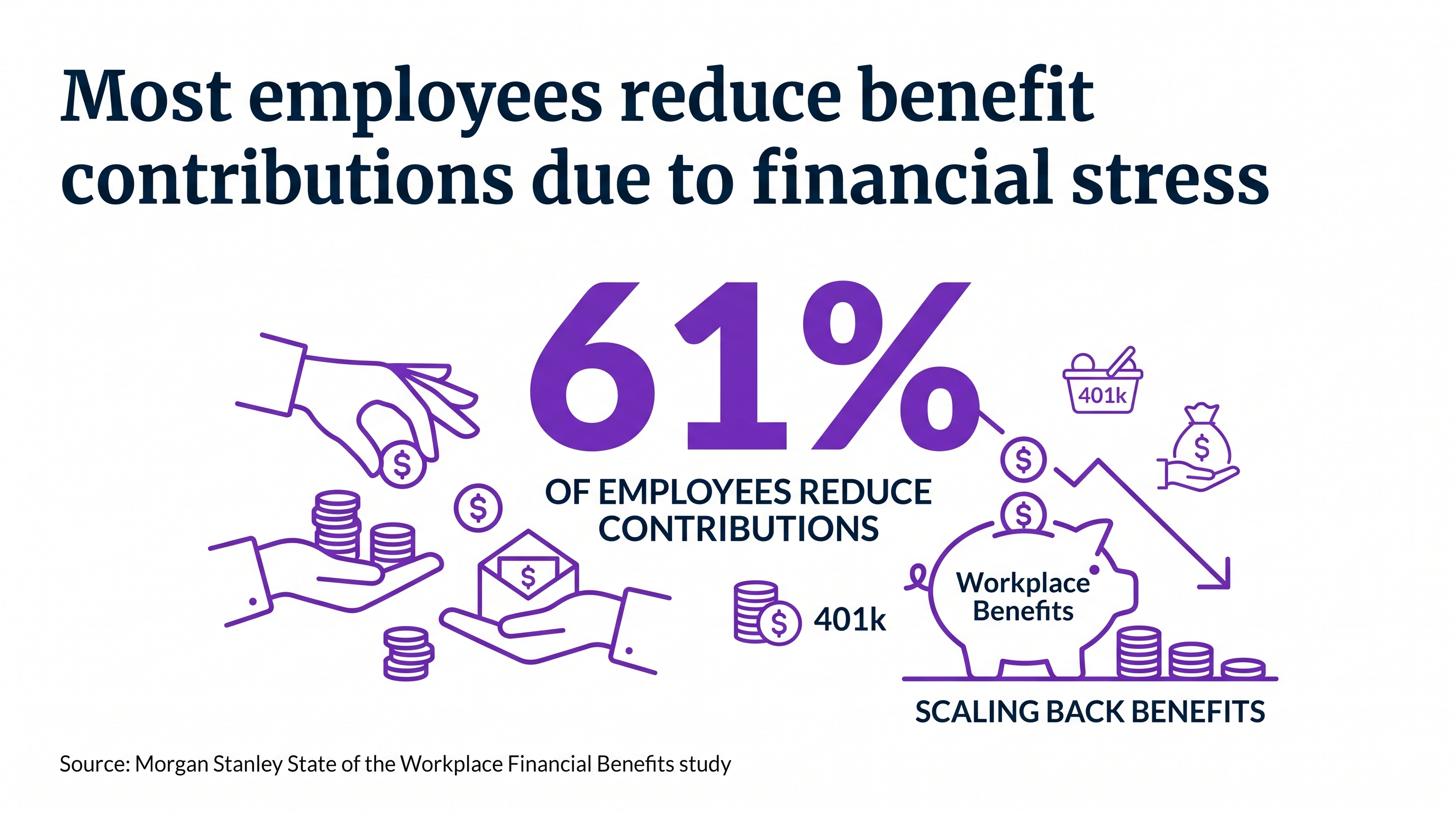
61% of employees reduce benefit contributions due to financial stress. Icons depict coins and declining charts.
Visualization created with AI assistance based on original reporting.
  • Key Insight: Learn how integrated, guidance-led financial benefits are reshaping employee retention strategies.
  • What's at Stake: Inadequate benefits risk productivity declines and accelerated turnover during tighter hiring markets.
  • Supporting Data: 61% of employees say they're reducing workplace benefits contributions.
    Source: Bullets generated by AI with editorial review

More than half of U.S. employees say that financial stress is affecting their work, and many are scaling back contributions to workplace benefits, according to a new Morgan Stanley report. 

Processing Content

The company's sixth annual State of the Workplace Financial Benefits study comes amid heightened recession concerns and rising energy prices driven by the conflict in Iran. 

Eighty percent of HR managers say employees' financial issues hurt productivity, and 53% say financial stress-reducing benefits matter most for job satisfaction, ahead of mental or emotional support (26%) and physical wellness benefits (19%). 

Employees are in agreement: 56% report that financial stress negatively impacts their work, and 61% are reducing contributions to workplace benefits. 

"Concerns over macro trends like inflation or the job market seemed to have resulted in employees reducing contributions to workplace benefits, including 401Ks and savings accounts," Craig Rubino, head of corporate relationship management and engagement at Morgan Stanley at Work, said in an email interview.

Read more: Alarm over rising fuel costs adds to employee financial stress

The research from Morgan Stanley also highlights how workplace financial benefits can drive employee satisfaction, engagement and retention. 

Most employees want more support with financial planning, with 73% saying they need to accelerate their efforts and 84% reporting financial issues over the past year. The most common issues were with budgeting (39%), financial goal setting (35%) and retirement planning (34%). 

"Our 2026 insights show employees continue to turn to their employers for support with personal financial needs, and employers help meet those needs through a full spectrum of workplace financial benefits," Scott Whatley, head of Morgan Stanley at Work, said in a statement. "Companies that invest in comprehensive offerings that include financial planning and education are better positioned to support productivity, strengthen engagement and retain talent in an environment where needs and expectations continue to grow."

The Morgan Stanley at Work Employees Survey and HR Leaders Survey, conducted by Wakefield Research, surveyed 1,000 employed U.S. adults and 600 HR leaders. 

Growing focus on retention

Financial benefits also play a key role in attracting and retaining talent. Eighty-five percent of employees say they would feel more invested in their company if it offered financial benefits tailored to their needs, and 91% would consider switching jobs for benefits that help them reach their goals. 

Those findings coincide with a growing focus on retention and hiring among employers. Sixty-five percent of HR executives say hiring and retention is their company's top strategic financial priority for 2026 — a 6 percentage point year-over-year increase. 

The study also found that equity compensation is a major driver of employee motivation and engagement, with three-quarters of employees and 85% of HR leaders calling it the most effective tool for motivating workers. 

Read more: Rising costs turn financial strain into a way of life for workers

Employees say the biggest benefit of equity compensation is helping them reach long-term financial goals like retirement (28%), while HR leaders are more likely to point to giving workers a stake in the company's success (33%). 

"Equity compensation continues to resonate as a meaningful driver of motivation, and employees understand equity as a way to unlock long-term value for their personal financial goals," Kate Winget, chief revenue officer of Morgan Stanley at Work, said in a statement. "This presents a powerful opportunity for employers to link employee motivation and engagement with company success, and education is key in forging this connection."

Although the economic outlook for the year remains uncertain, Rubino said companies that build integrated, guidance-driven financial benefits programs will be best positioned to attract, engage and retain talent.

"As the labor market is shaped by AI adoption and a tighter hiring environment, employees increasingly value workplace benefits that provide stability and long-term financial support," he said.  


For reprint and licensing requests for this article, click here.
Financial wellness Employee benefits Employee retention Compensation
MORE FROM EMPLOYEE BENEFIT NEWS
Load More